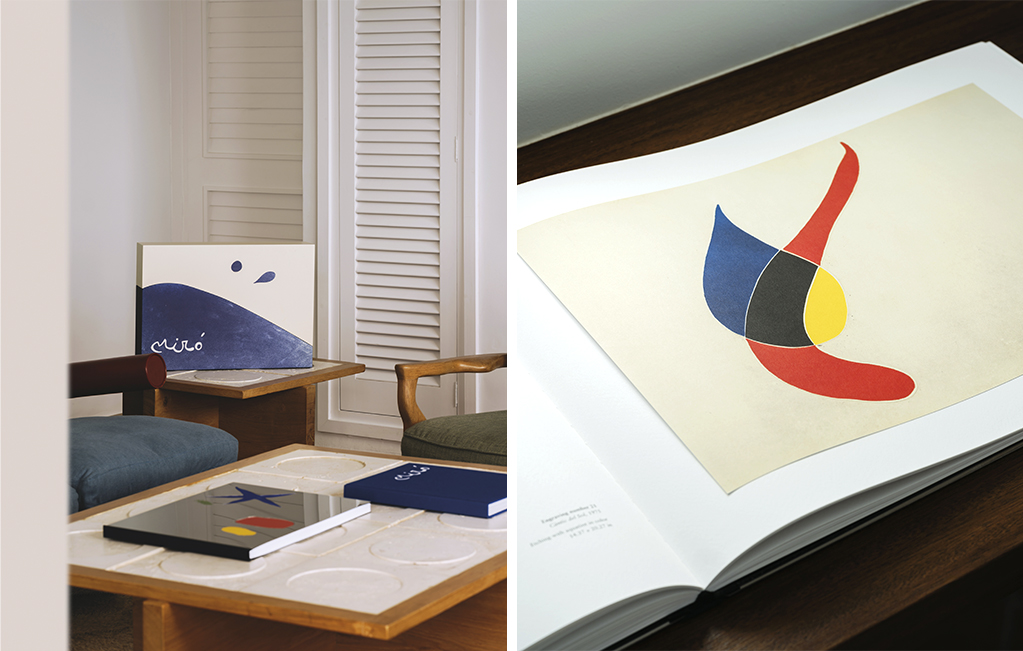


The printmaker’s technique: how Miró mastered etching and aquatint and made them his own language
“If I attack a piece of wood with a gouge, this puts me in a certain state of mind. The encounter between the material and the instrument creates a living shock that, I believe, will resonate with the viewer” (quote by Joan Miró taken from the Study Book of Canticle of the Sun).
This is how Miró understood the act of creation: as a physical and spiritual encounter between the hand, the tool and the material. That is why, when he collaborated with master printmaker Joan Barberà i Gómez to give form to the visual universe of Canticle of the Sun, he was not approaching the medium as a beginner: the artist already had more than four decades of constant experimentation in printmaking workshops behind him.
His experience began in the 1930s, when he took his first steps in lithography to illustrate a book by Tristan Tzara. In 1932 and 1933, in the Paris studio of the painter, printmaker and Cubist master Louis Marcoussis, Miró came into contact with etching and drypoint, two techniques that would decisively expand his visual language. Later, fleeing the Second World War, he moved his studio to New York. It was there, in 1947, that he intensely explored the combination of etching and aquatint, mastering them with extraordinary command and turning them into the soul of much of his later work.
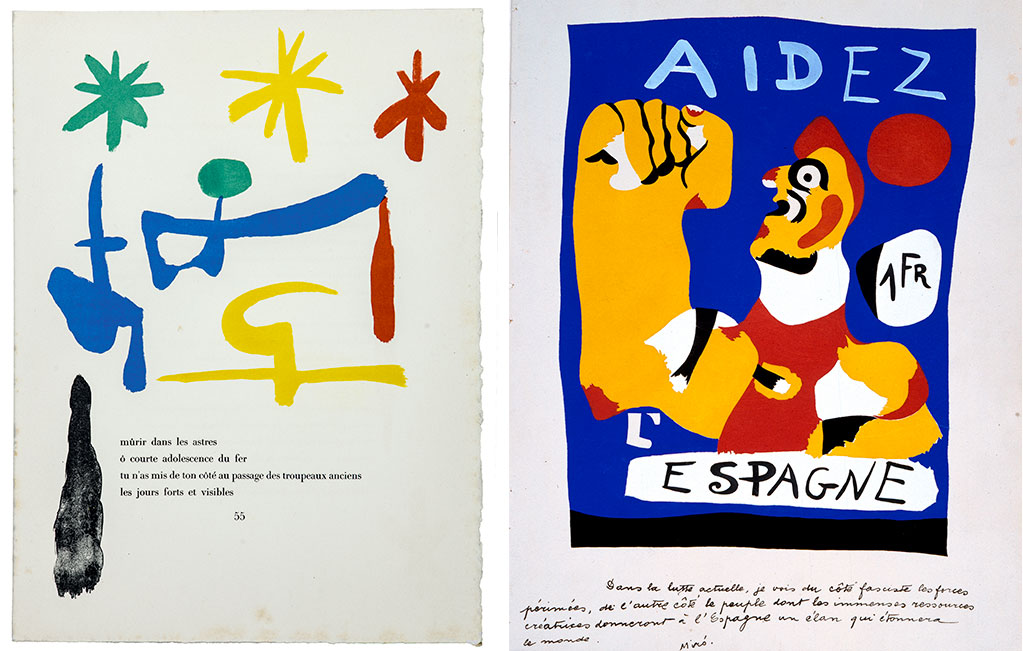
Left: Tristan TZARA and Joan MIRÓ. Parler Seul, 1948–1950. Maeght Éditeur. Lithograph, 18.2 × 28.9 cm. © Successió Miró Archive
Right: Aidez l’Espagne. Cahiers d’Art (Paris), nos. 4–5, 1937. © Fundació Joan Miró, Barcelona
His extensive graphic output established him not only as one of the great printmakers of the twentieth century, but of art history itself. Far from conforming to traditional forms, he expanded their limits by exploring every possible terrain: from the delicacy of drypoint to the rough texture of carborundum, through linocut, lithography and, of course, aquatint.
For Miró, printmaking was never a secondary discipline: it was a territory of freedom, a space where his artistic vision breathed with particular intensity and maintained a living, daring and constantly evolving dialogue with his painting.
The dialogue between metal and acid
The 33 prints that make up Canticle of the Sun combine the traditional techniques of etching and aquatint. Both belong to the field of intaglio printmaking, an artisanal process in which incisions are made on a copper plate. The depth of these grooves determines the amount of ink they hold and, therefore, the intensity of the mark left by the colour when the paper passes through the press. While aquatint is ideal for creating stains and very subtle colour gradations, etching defines the line, the detail and the shading.
Miró understood the demands of the support, but he did not submit to them passively: he stretched them, diverted them and, when necessary, pushed them into unexpected territory. On occasion, he used unorthodox tools and allowed chance to take on a central role in his working process.
Etching allows one to draw with acid: a precise alchemy of protection, incision and corrosion. First, the copper plate is covered with a protective varnish, and then the artist draws on it, removing the varnish and leaving the copper exposed.
The key moment comes when the plate is immersed in the acid bath. The acid corrodes the exposed areas. The longer the plate remains in the acid, the deeper the lines become and the darker the ink will appear when printed under the press.
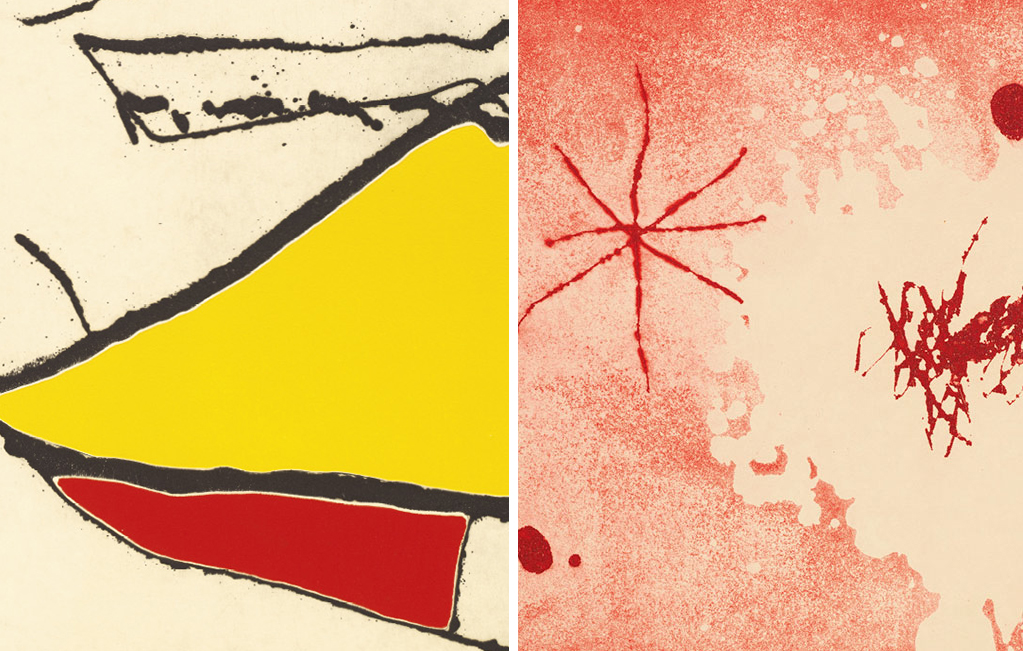
Left detail: Engraving no. 26. Càntic del Sol, 1975. Colour etching and aquatint, 36.5 × 51.5 cm. © Fundació Joan Miró, Barcelona
Right detail: Engraving no. 24. Càntic del Sol, 1975. Colour etching and aquatint, 36.5 × 51.5 cm. © Fundació Joan Miró, Barcelona
If etching is used to create the lines of the drawing, aquatint is perfect for producing areas of colour, shadows and textures. The process is particularly distinctive: instead of using a liquid varnish, a fine resin powder is dusted over the copper plate. The plate is then heated from below so that the tiny grains melt and adhere to the metal. When the plate is immersed in acid, the acid cannot bite into the areas covered by resin, but it does seep into the minute spaces between each grain. The result on paper is not a line, but a delicate, vibrant stippled effect that imitates shadows and gradations. Because these incisions are shallower than those of etching, the acid bath is much quicker.
In Canticle of the Sun, Miró took this technique one step further by using sugar-lift aquatint. This method allowed him to paint directly onto the metal with a mixture of water, ink and sugar, just as he would with a brush on canvas. This ingenious resource gave him a freedom and spontaneity rarely found in traditional printmaking, making his pieces resemble authentic watercolours or ink drawings full of life.
The craftsmanship behind Canticle of the Sun
The greatest challenge of this edition lay not only in visual fidelity, but in something more tangible and subtle: capturing the tactile soul of Joan Miró’s graphic language. Reproducing with precision the grooves and relief of his plates required an extraordinary feat of craftsmanship. The result is not a mere reproduction, but a respectful encounter with the universe of an artist in full creative maturity.
To contemplate these plates and perceive their relief with the fingertips is to surrender to a sensory experience. Through matter, the artist tells us a story in which nature is the great protagonist; a living narrative in which each print possesses a texture that makes it unrepeatable.
In print number two, created using the techniques of etching and aquatint, the sun is not a flat circle, but a luminous body fragmented into two distinct stages and colours. The paper becomes a stage on which light divides, inviting the eye to discover the boundary between its two realities.
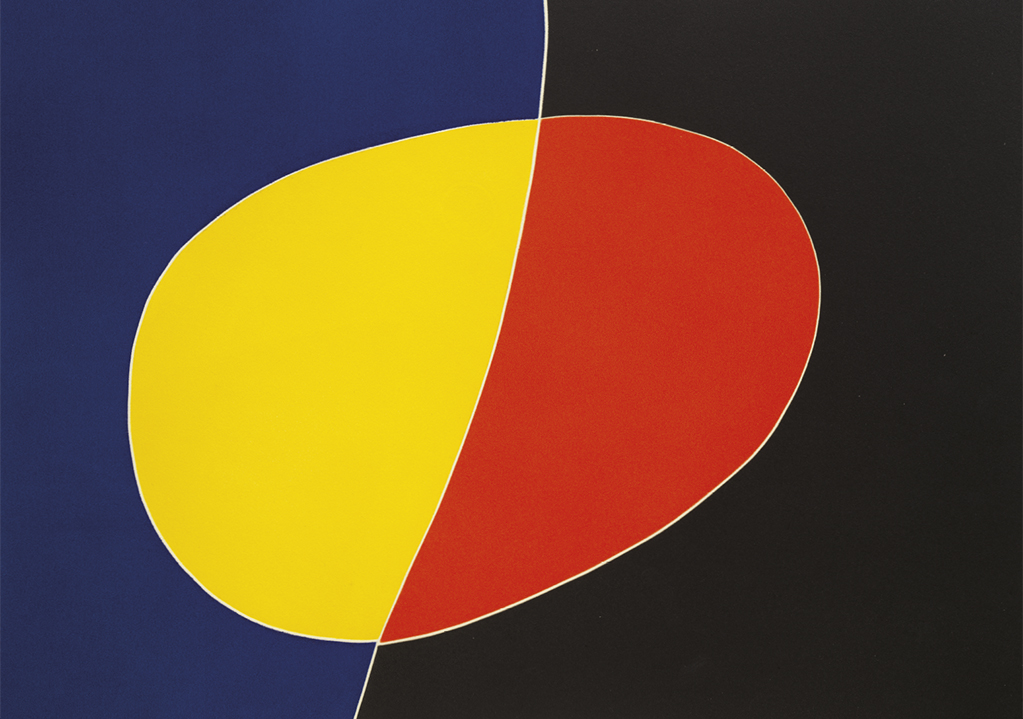
Engraving no. 2. Càntic del Sol, 1975. Colour etching and aquatint, 36.5 × 51.5 cm. © Fundació Joan Miró, Barcelona
In print number five, the sensory journey begins in the background. An atmosphere of grey aquatint, printed from a single plate, brings serene depth. Against this sky, the forms in blue, yellow and green emerge with a volume of their own thanks to the use of separate elements.
The visual and tactile climax arrives with the second plate: the black lines, the calligraphic star in the upper right-hand corner and an evocative red figure. Here, Miró combines traditional etching with the audacity of sugar-lift aquatint and resin. The result is a black line of fluid, almost calligraphic appearance, while the acid bites into the metal between the areas protected by resin to create a granular surface structure: a rough relief that vibrates to the touch.
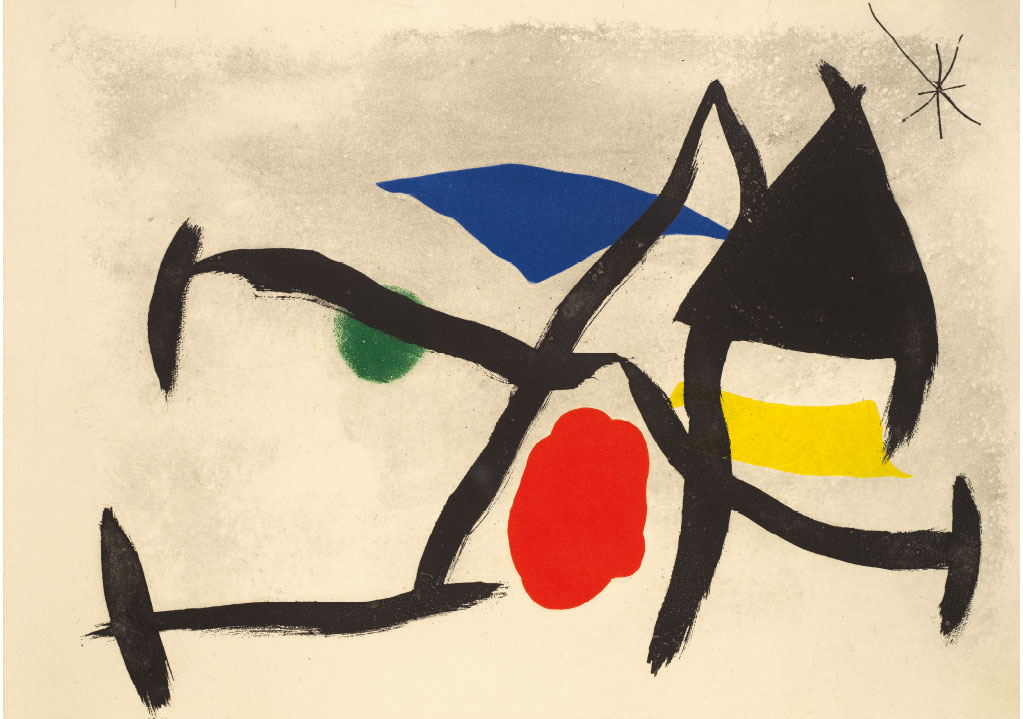
Engraving no. 5. Càntic del Sol, 1975. Colour etching and aquatint, 36.5 × 51.5 cm. © Fundació Joan Miró, Barcelona
Finally, in print number 22, complexity is transformed into pure sensory poetry. The hypnotic, liquefied effect of the blue washes is achieved through sugar-lift aquatint, together with a dusting of powdered resin that gives the entire surface a granular, almost organic relief. By contrast, the green form was cut out of the plate, its edges carefully polished to create a clean relief that both sinks into and emerges from the paper.
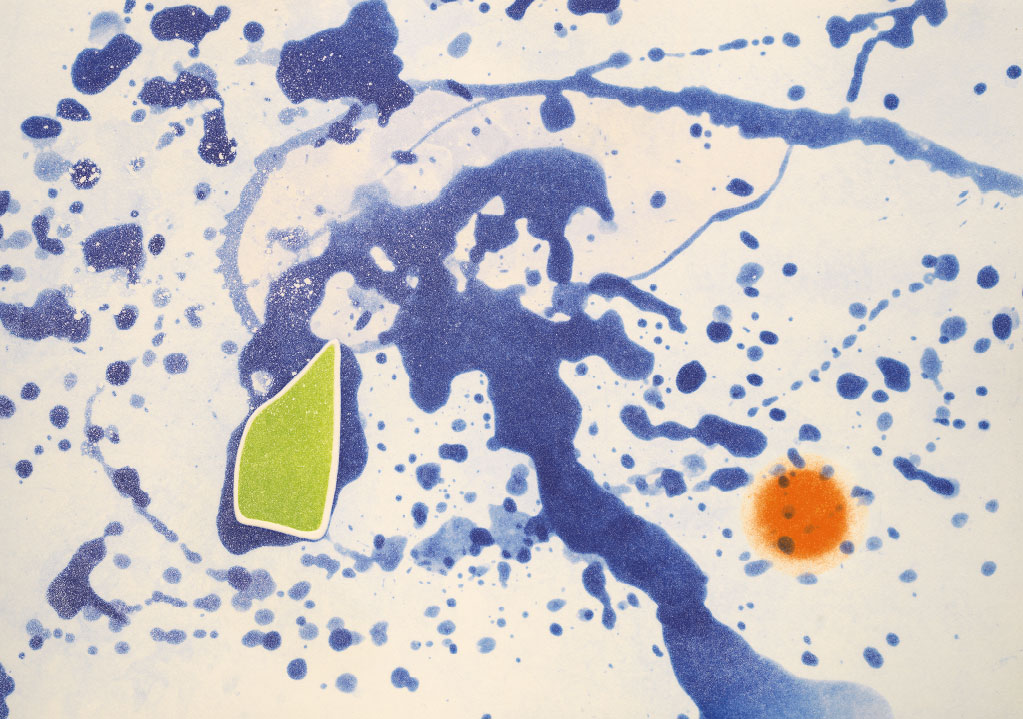
Engraving no. 22. Càntic del Sol, 1975. Colour etching and aquatint, 36.5 × 51.5 cm. © Fundació Joan Miró, Barcelona
This is how Canticle of the Sun transcends the concept of the artist’s book to become an experience of contemplation. A bridge between Miró’s visual history and the reader’s sensibility, where nature, sign and matter merge in a single celebration.
Canticle of the Sun: the masterpiece that captures Joan Miró’s universe
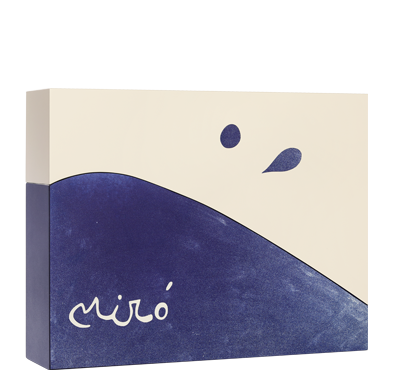
– Composed of two volumes and a case of powerful symbolic resonance, this edition pays tribute to print number 20 from Miró’s most iconic series.
– The Art Book reproduces the 33 plates that make up the work at 75% of their original size.
– The Study Book traces Miró’s entire career, from his early years in Mont-roig to his full artistic maturity, which culminates in this great work, through the contributions of experts Robert Lubar Messeri, Mercedes Durban Monreal and Jacques Dalarun.