

Remembering Antoni Gaudí’s eternal legacy
On 25 June 1852, the city of Reus welcomed the birth of Antoni Gaudí i Cornet, a figure who would go on to transcend the boundaries of architecture and become an icon of international art. He grew up in a humble, hardworking family connected to the traditional craft of coppersmithing. In the family workshop, surrounded by tools and the process of shaping metal, he developed an early sensitivity to volume, form and the behaviour of materials, long before receiving any formal education.
Driven by an innate gift that was already beginning to reveal itself, he moved to Barcelona to study at the Barcelona School of Architecture between 1873 and 1878. In fact, only four students graduated in his class, among them the creator who would mark a turning point in Catalan architecture. Yet academia was never truly his home. His detachment from conventional teaching methods has often been noted. Although he displayed an unconventional creative personality, he quickly understood that the modern architect needed to combine technical, artistic and historical knowledge. In short, he was a multifaceted spirit, able to move effortlessly between disciplines and become one of the most distinctive creators of his time.
In 2026, the centenary of his death, his legacy resonates more strongly than ever: a reminder that although he physically left us in 1926, his work continues to radiate the same creative force across Barcelona as it did a century ago.
The solstice of a genius
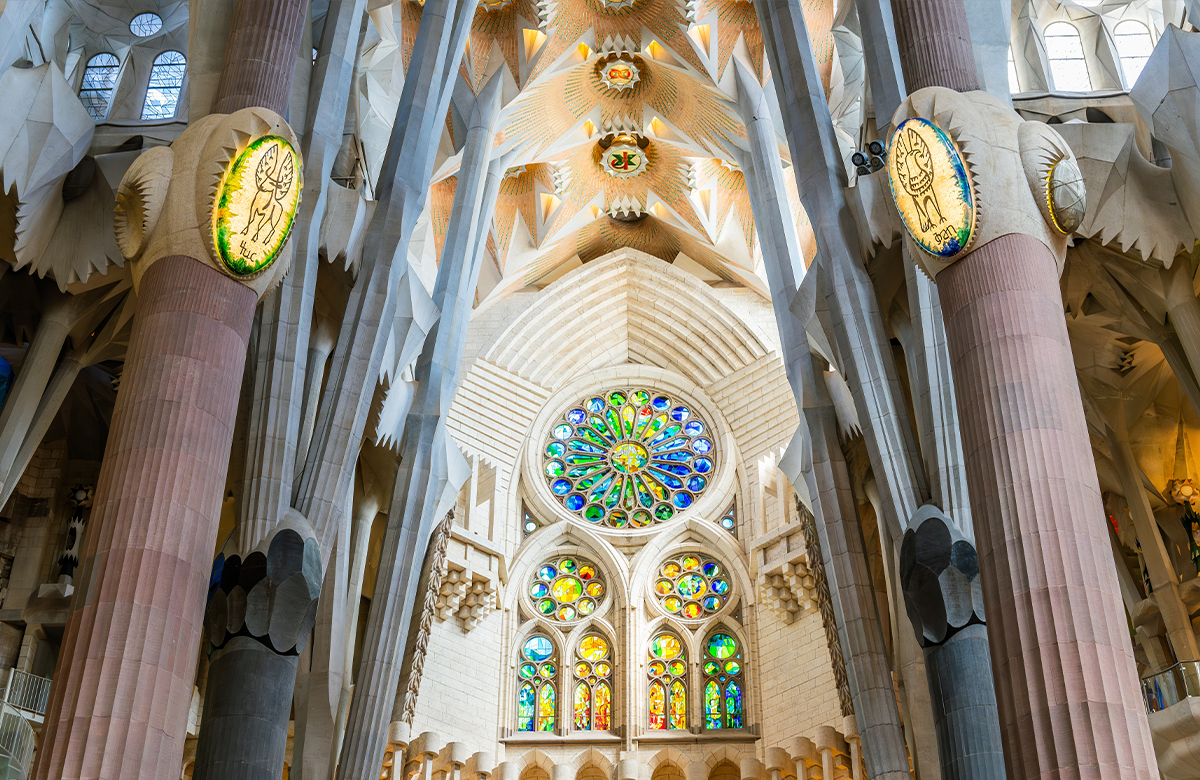
Interior of the Sagrada Familia, Barcelona.
For the artistic world, June is not merely another date on the calendar. It is the moment when light reaches its fullest splendour, bathing forms and revealing nuances that only the eye of a genius can truly capture. It is also a key period in the memory of Antoni Gaudí: the month in which he was born and the month in which the architect passed away, while also marking the celebration of World Art Nouveau Day, the movement that broke with the aesthetics of the past and embraced the organic forms of nature.
In this context, Gaudí’s figure takes on special significance. Throughout his career, he created some of the most emblematic works of European Art Nouveau, giving Barcelona a unique and distinctive character and transforming the city into a magnet that attracts millions of visitors each year eager to discover his architectural language.
10 June, the day this genius departed from the world, has become a landmark date on the global calendar: a tribute to an exceptional figure who, through his organic forms, innovative structural solutions and extraordinary richness of colour, remains more present than ever today.
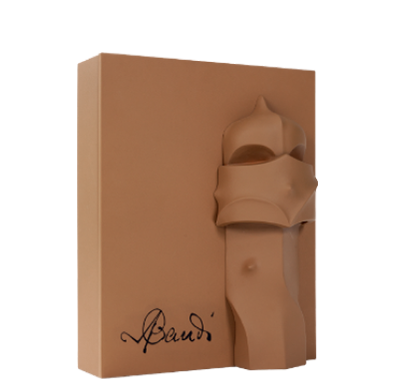
A collection of Gaudí’s drawings
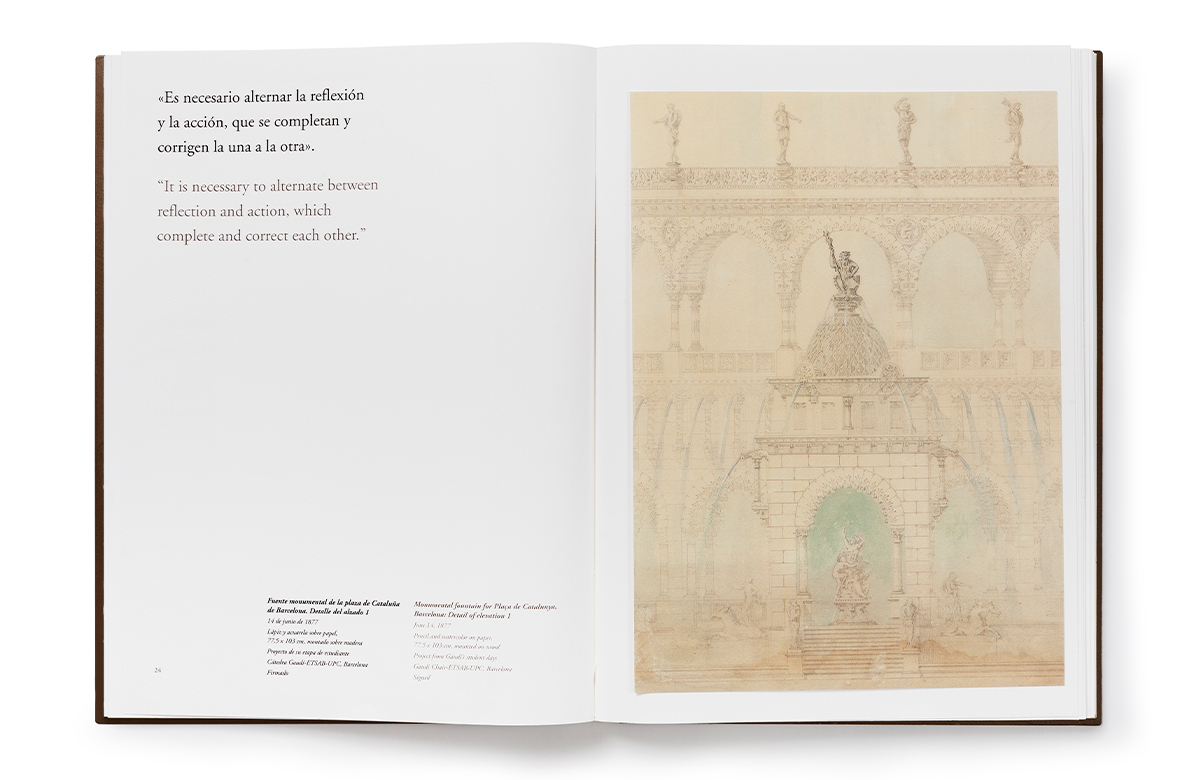
Image from the Art Book featuring the plate ‘Monumental Fountain in Plaça de Catalunya, Barcelona.’ Detail of Elevation 1, 1877.
Although part of the architect’s archive was lost in the fire of July 1936 during the Spanish Civil War, numerous plans, sketches and drawings survive, offering valuable insight into the evolution of his creative thinking. These documents include both proposals submitted to Barcelona City Council and others that remained solely within the artist’s imagination.
Created during his years as an architecture student, these sketches reveal the creative ambition that already defined his style. Many of the projects emerged from commissions assigned to his university professors; while working as an assistant to some of them, the young architect seized every opportunity to go one step further, proposing innovative solutions.
Among them is the design for a monumental fountain intended for the redevelopment of Plaça de Catalunya, a proposal of remarkable formal audacity that anticipated many of the features that would later define his architectural language. Yet the technical complexity of such structures meant that many of his early ideas could not be realised in practice. As a result, numerous projects from his formative years remained on paper, standing as testimony to his boundless imagination.
Barcelona’s iconic buildings
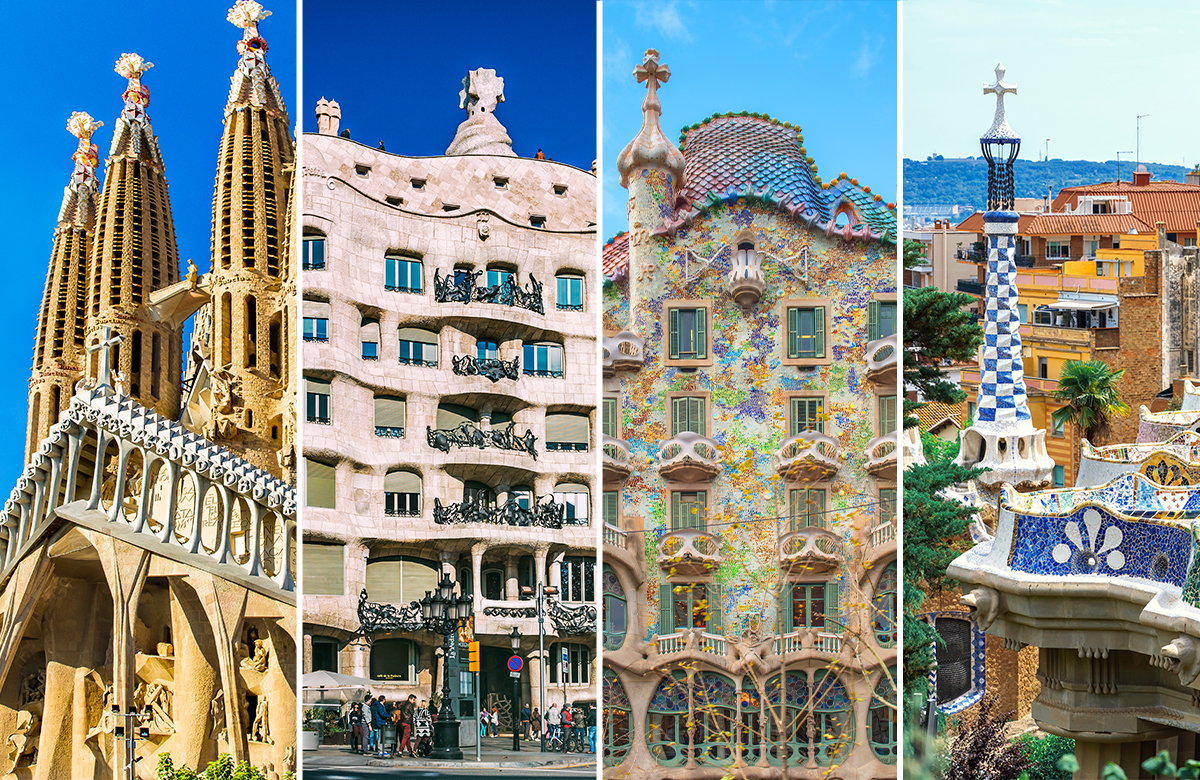
Images of the Sagrada Familia, La Pedrera, Casa Batlló and Park Güell.
Among the many architectural designs he conceived, several played a decisive role in shaping Barcelona’s visual identity, endowing the city with a unique Art Nouveau character. Today, the Catalan capital would not be the same without landmark works such as the Sagrada Familia, an architectural dream that continues to move towards completion more than a century after construction began. Equally remarkable are the organic, marine-inspired forms of La Pedrera and Casa Batlló on Passeig de Gràcia, as well as the perfect symbiosis of nature and colour that animates Park Güell.
A dialogue between masters: when Miró drew inspiration from Gaudí’s light
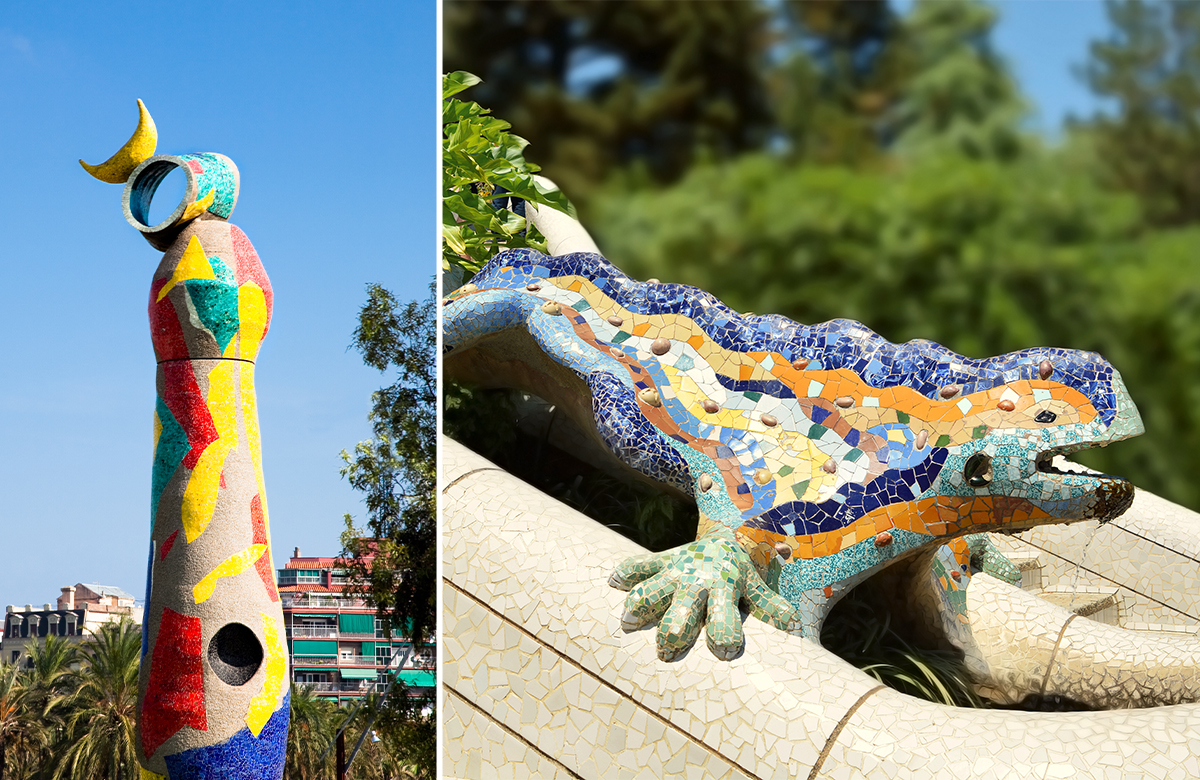
Left: Dona i Ocell, 1983.
Right: detail of the lizard at Park Güell, 1926.
In 1979, Joan Miró, together with master printmaker Joan Barbarà, decided to pay tribute to Antoni Gaudí. It was during the creation of the murals for UNESCO in Paris that Miró found in Gaudí’s work a source of inspiration that continued to grow over the years.
Miró’s admiration for Gaudí becomes entirely understandable when one considers the affinities between the two creators. Both shared a profound connection with nature, a fascination with decorative motifs and a constant desire to explore new expressive possibilities. They also developed deeply personal artistic languages, free from convention, establishing themselves as essential figures in twentieth-century Catalan art.
Trencadís, the Art Nouveau technique based on brightly coloured ceramic fragments, became the starting point for Miró’s series of 21 etchings created as a tribute to the architect.
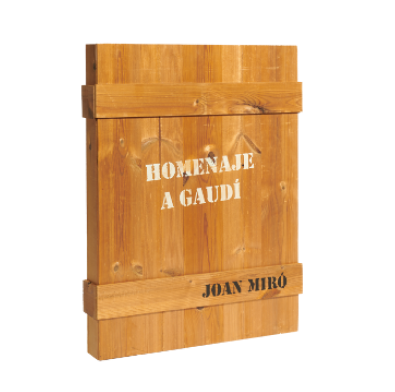
ARTIKA brought this project to life through Homenaje a Gaudí by Joan Miró, an edition that is now sold out. That same dialogue between nature, experimentation and creative freedom is also present in Canticle of the Sun, one of the most outstanding Miró editions currently available in the ARTIKA catalogue.
Canticle of the Sun: An introduction to Joan Miró’s universe
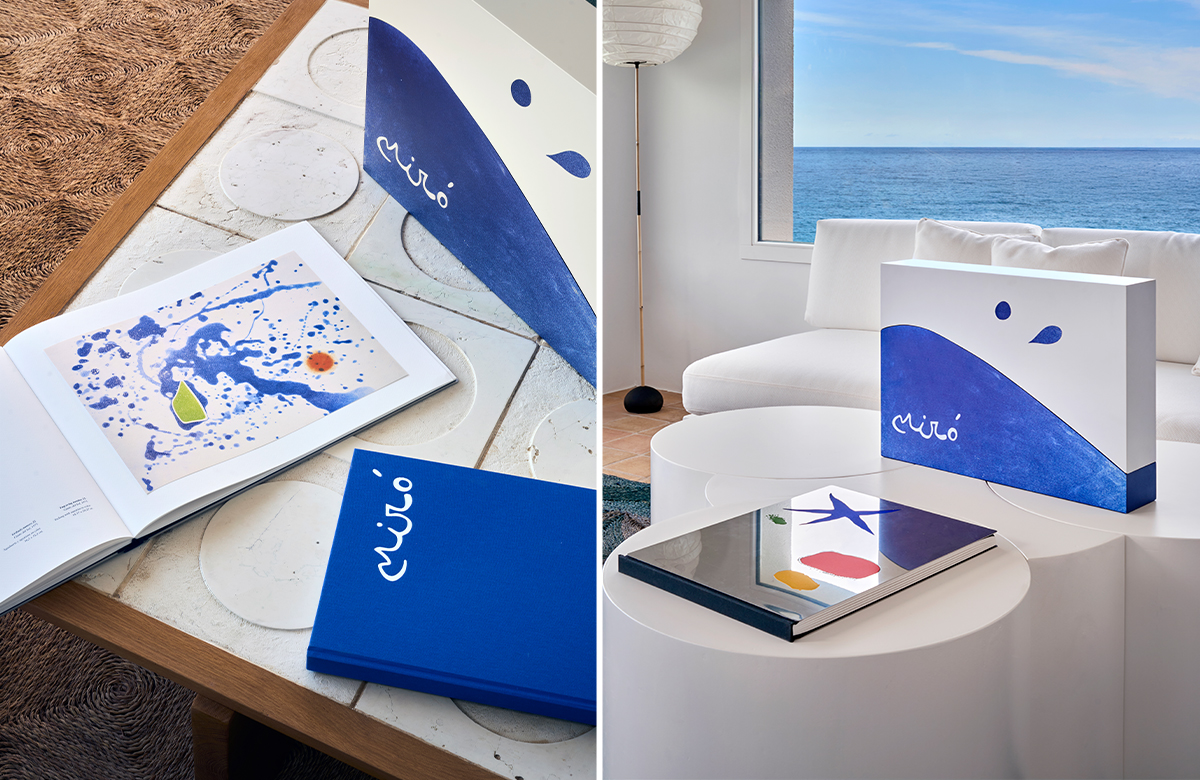
– An exclusive, limited and numbered edition.
– The edition consists of two volumes and a symbolic case that pays tribute to print number 20 from one of Miró’s most characteristic graphic series.
– The Art Book reproduces 33 plates at 75% of their original size.
– The Study Book traces Miró’s entire artistic journey, from his beginnings in Mont-roig to his mature years, culminating in this major work through the perspectives of renowned experts Robert Lubar Messeri, Mercedes Durban Monreal and Jacques Dalarun.