

Michelangelo Buonarroti: the hand that shaped the Renaissance
For centuries, few artists have embodied the idea of art as an absolute pursuit with such intensity. Over more than seventy years of tireless work, Michelangelo explored sculpture, painting, architecture and even poetry. His monumental imagination and extraordinary visual intelligence made him a figure admired by his contemporaries and one of the defining figures of the Renaissance.
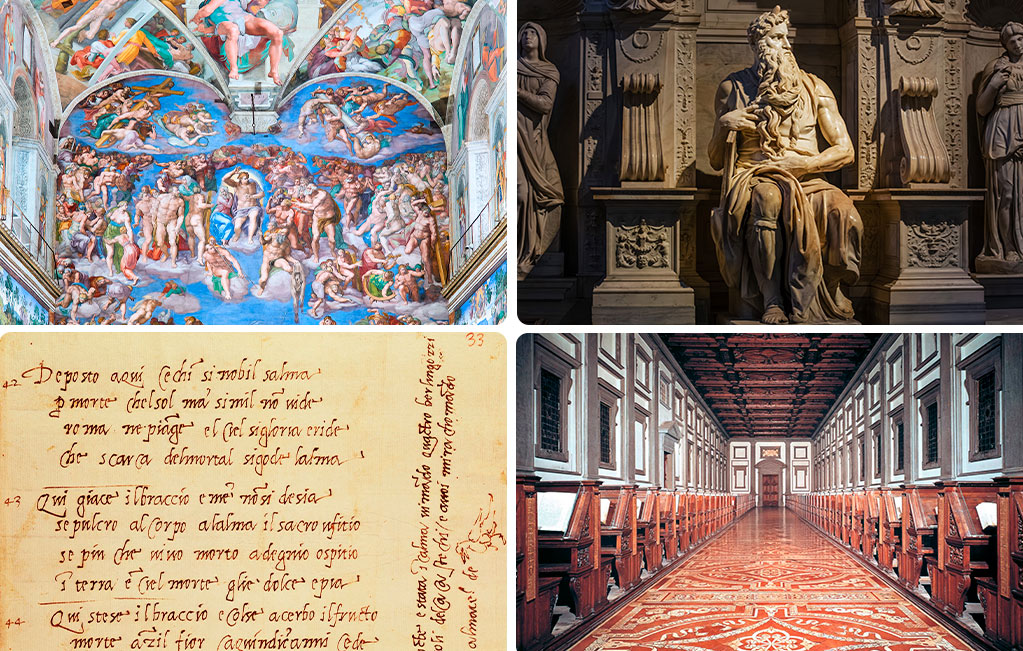
Upper left: The Last Judgment (Sistine Chapel), 1536–1541.
Upper right: Moses, 1513–1515. San Pietro in Vincoli, Rome, Italy.
Lower right: Manuscript of a poem by Michelangelo Buonarroti.
Lower right: Reading Room of the Laurentian Library, 1519–1534, Florence, Italy.
Today, his work is universally recognised, yet the origins of that vision remain less widely known. Where does such immense talent come from? What roots, losses, affections and lessons shaped one of the most decisive creators in the history of art? To understand him better, we must delve into his story.
The origins of a Renaissance master
Michelangelo was born in 1475 in Caprese, a small town in Tuscany, where his father, Lodovico Buonarroti, briefly served as mayor. His mother, Francesca, died when he was six years old, leaving his father to care for him and his four brothers.
He spent his childhood in Florence, in a family of bankers and merchants who made it possible for him to receive a good education. An abacus master taught him the basic principles of arithmetic and geometry, and he also attended grammar school, where he complemented his Christian education with knowledge of several classical authors and modern poetry. This early training nurtured a vision capable of bringing together business, technical discipline, humanist culture and poetic sensitivity.
From a very young age, he revealed an exceptional inclination for drawing and an artistic drive that could not be contained. And so, at just 13 years old, he entered the Florentine workshop of the painter Domenico Ghirlandaio (1449–1494) as an apprentice.
First steps towards greatness
During his years as Ghirlandaio’s pupil, he absorbed the principles of design and the practice of tempera, oil and fresco painting. He also became familiar with the structure and management of a successful artist’s workshop.
Before long, he caught the attention of the city’s ruler, Lorenzo de’ Medici, who admitted him to his sculpture garden. There, under the guidance of the sculptor Bertoldo di Giovanni, a pupil of Donatello, Michelangelo came into contact with classical sculpture and the innovative forms of the early Renaissance. Donatello would remain an artist for whom Michelangelo always felt profound admiration.
His distant kinship with the Medici and, above all, his talent opened the doors of Lorenzo’s court, where he lived in close contact with a circle of poets and humanists. That environment placed him at the heart of an intellectually vibrant Florence, where faith, classical beauty and humanist thought were in constant dialogue.
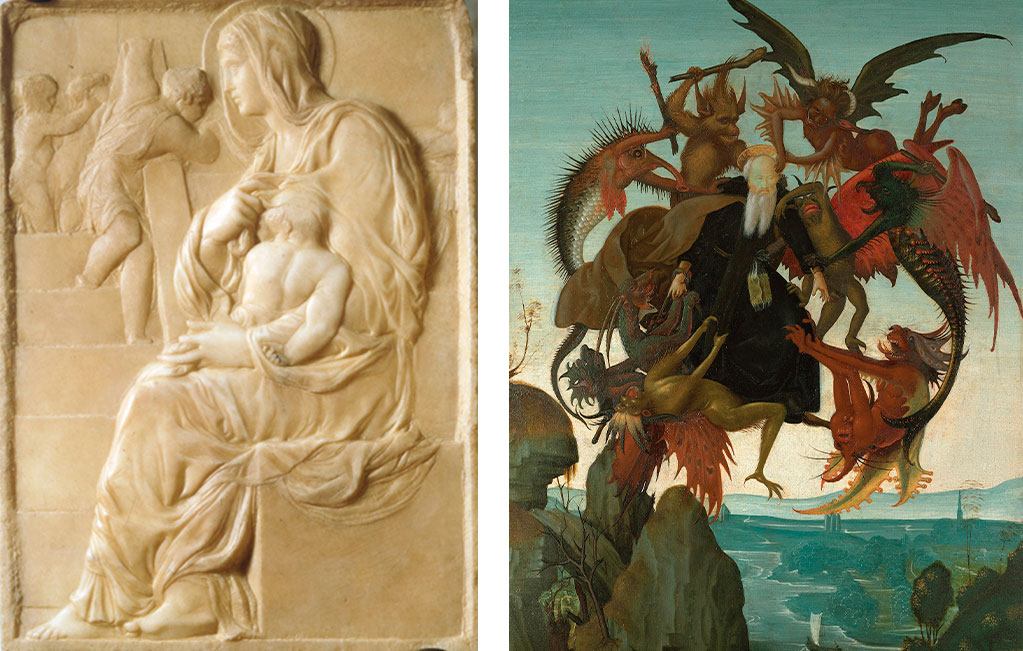
Upper left: Madonna of the Stairs, c. 1491, marble. Casa Buonarroti, Florence, Italy.
Right: The Torment of Saint Anthony, 1487–1489, tempera and oil on panel, 47 × 35 cm. His earliest known work. Kimbell Art Museum, Fort Worth, Texas.
The artistic legacy of Michelangelo
From the beginning, his great obsession was to understand and represent the human body. He approached it as a sculptor, painter, architect and poet, transforming anatomy into a territory of study, emotion and transcendence.
In his earliest works as an independent master, we already find that combination of agile elegance and contained vulnerability that anticipates the monumental power of David. In this figure, the body seems to vibrate from within. Its silent tension emerges from the dialogue between the classical ideals of Greece and a deeply human spirituality. The body ceases to be mere form: it becomes a territory of perfection, unrest and transcendence.
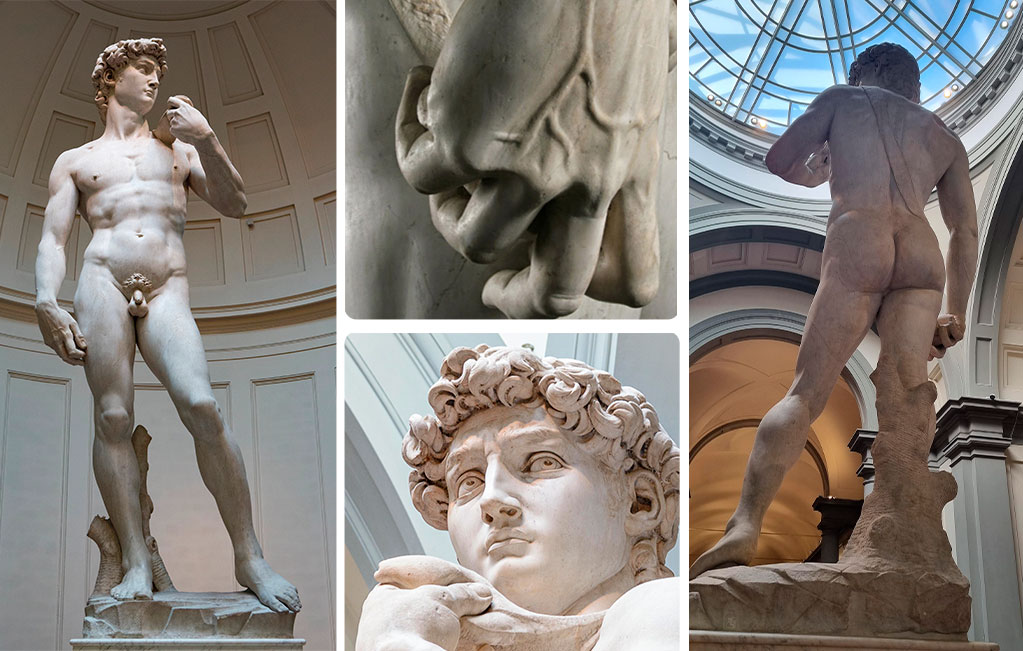
David, 1501–1504. Galleria dell’Accademia, Florence, Italy.
Between 1497 and 1498, Michelangelo sculpted Baco, the god of wine, in a work that challenged the taste of its time. At first glance, it responds to classical beauty. Yet its forms reveal a man surrendered to pleasure. With the cup slightly tilted and the posture unstable, Bacchus seems to stagger in a suspended instant, a sensation that is only fully revealed when the sculpture is viewed from every angle.
Very different is the emotion conveyed by La Piedad, in which Michelangelo confronted the theme of death for the first time. The sculpture combines two figures on different scales to create an effect of unparalleled visual harmony. The marble, worked with great delicacy, seems to soften like wax in the folds of the mantle and in the softness of Christ’s body. It is a scene of painful serenity, in which technique reaches its highest expression by placing itself at the service of restrained emotion.
This investigation of the body did not stop at marble. It reached a monumental dimension in the vault of the Sistine Chapel, where Michelangelo transferred to fresco the tension, anatomy and spiritual energy that had shaped all his sculptural work, on an unprecedented scale and with unprecedented complexity. Every figure, every gesture and every muscular tension reveals the culmination of a life dedicated to exploring the limits of artistic creation.
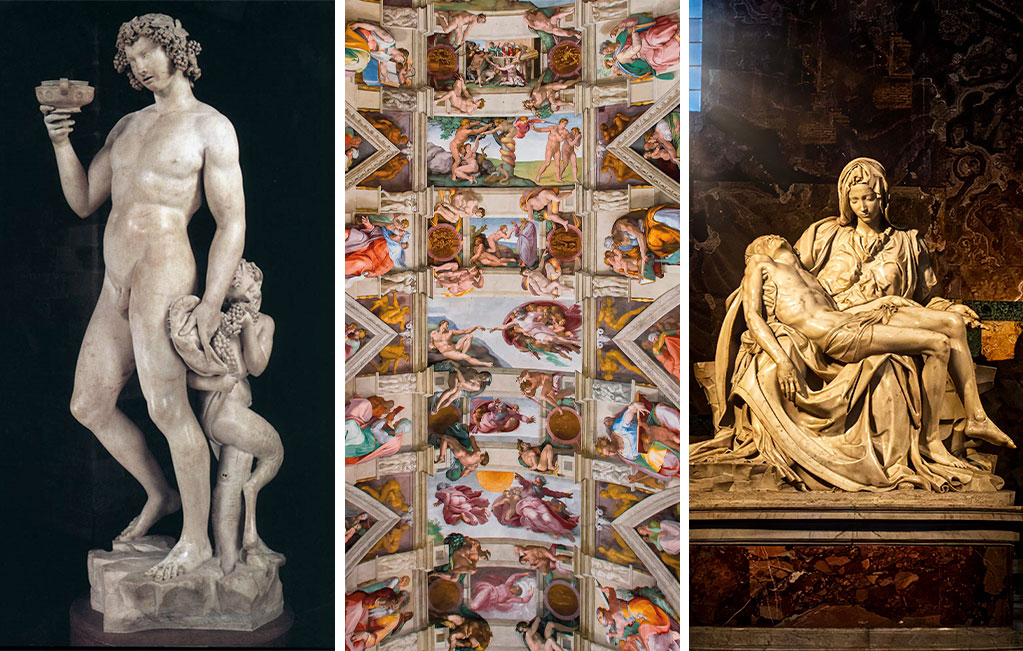
Left: Bacchus, marble sculpture, 1496–1497. Bargello Palace, Florence, Italy.
Centre: Ceiling of the Sistine Chapel, 1508–1512.
Right: Vatican Pietà, 1498–1499.
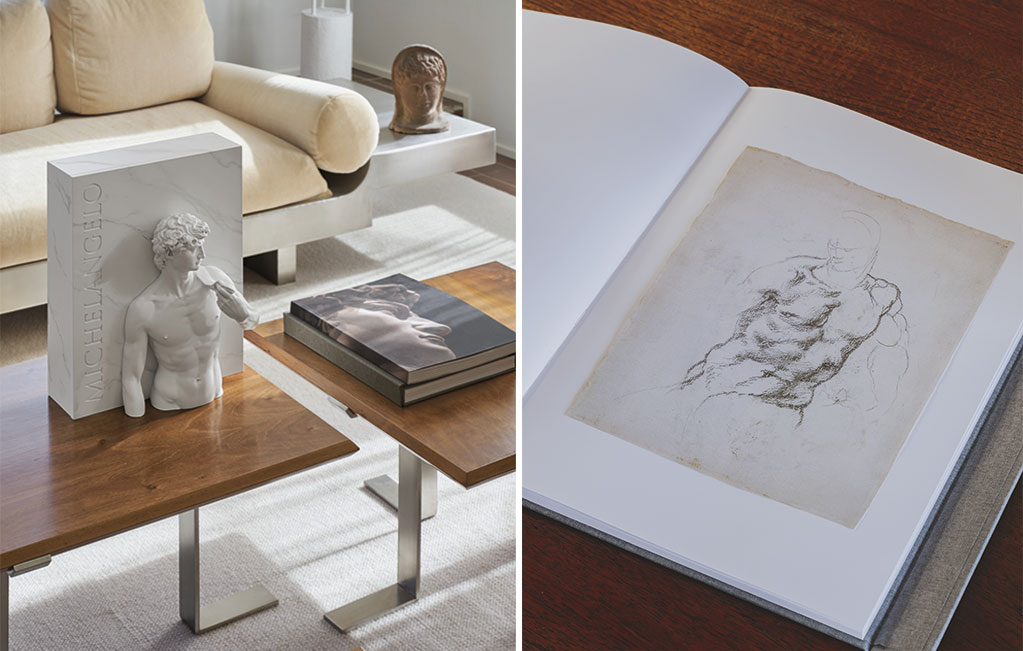
But before the marble, the fresco and the architecture, there was drawing. In his lines, the most intimate part of Michelangelo’s creative process is revealed: doubt, study, the search for perfect form. Where the finished work appears definitive, drawing shows the artist thinking
Michelangelo: unseen drawings by the greatest artist in history
– ARTIKA and the British Museum have joined forces to bring the public closer to one of the most important collections of Michelangelo’s drawings: an unprecedented opportunity to enter the artist’s mind through his most intimate works — his drawings.
– A numbered edition limited to 8,998 copies.
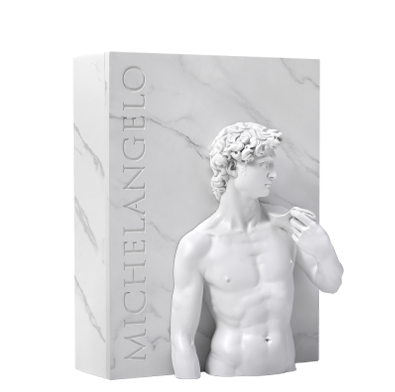
– The work is composed of two volumes and a spectacular sculptural case that pays tribute to David, the artist’s most famous sculpture.
– The Art Book presents 75 drawings by Michelangelo, 35 of them at actual size, reproduced to the highest standard.
– The Study Book brings together leading professionals and experts in the life and work of Michelangelo, enriching each drawing with their invaluable knowledge.