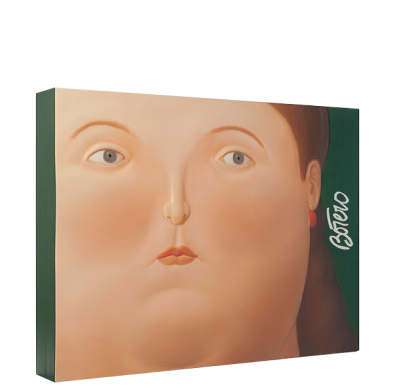


Botero: beauty as an act of resistance
Fernando Botero is one of the most instantly recognisable Latin American figures in contemporary art. His long career, spanning more than six decades, produced paintings, sculptures and drawings with an unmistakable visual identity, defined by volume, formal serenity and a powerful use of colour. His colossal figures, imposing and voluptuous — volumetric, not merely “fat”, as he himself insisted — have captivated generations of viewers.
A revolution in the history of Colombian art
To understand the scope of his commitment, it is essential to look to his roots. Botero is, arguably, the Colombian artist with the greatest international reach and a fundamental figure in the transformation of art in his country. In the mid-twentieth century, his work broke with the conventions of an artistic scene still dominated by traditional academicism. By giving his characters those monumental volumes and elevating everyday scenes — towns from Antioquia, priests, festivities — to an almost iconic dimension, he helped project a Colombian visual identity recognisable across the world.
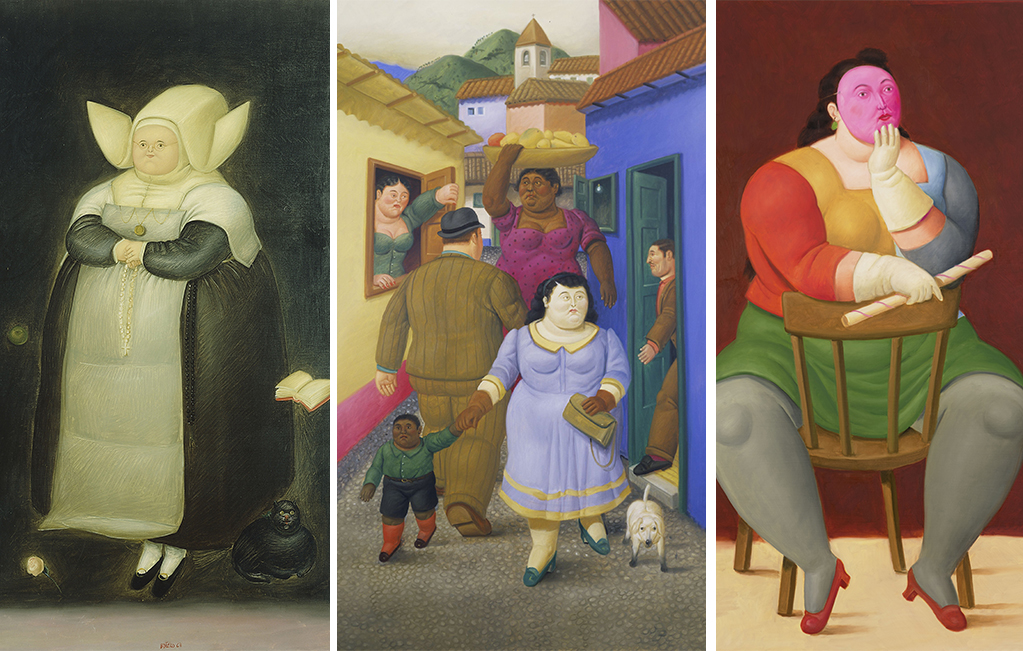
His influence extended far beyond aesthetics, becoming a bridge between Colombian art and international modernity. By succeeding in cities such as New York, Paris, Madrid and Florence, he demonstrated that the local could also become universal. His generosity, expressed through major donations to the Museo de Antioquia in Medellín and the Museo Botero in Bogotá, also helped democratise access to culture in a country marked by inequality. Through these donations, Botero turned an essential part of his legacy into a public heritage accessible to thousands of citizens.
From pain to protest
That deep connection to his homeland meant that Botero could not remain indifferent to the violence that marked his time. Although his art is often associated with satire and an apparent gentleness, the painter devoted major series to the brutality of Colombian violence and, later, to the torture inflicted on prisoners at Abu Ghraib prison in Iraq.
This series marked a turning point in the public perception of the artist. Although it focused on a specific episode of the US-led invasion of Iraq, audiences immediately understood those works as a universal indictment of cruelty and dehumanisation. Some critics even placed the series in dialogue with some of the most powerful anti-war images in the history of art, such as Goya’s The Disasters of War and Picasso’s Guernica. With these series, Botero proved himself to be an artist capable of speaking to very diverse audiences without sacrificing complexity: someone able to transform collective pain into an image that challenges us, moves us and demands remembrance.
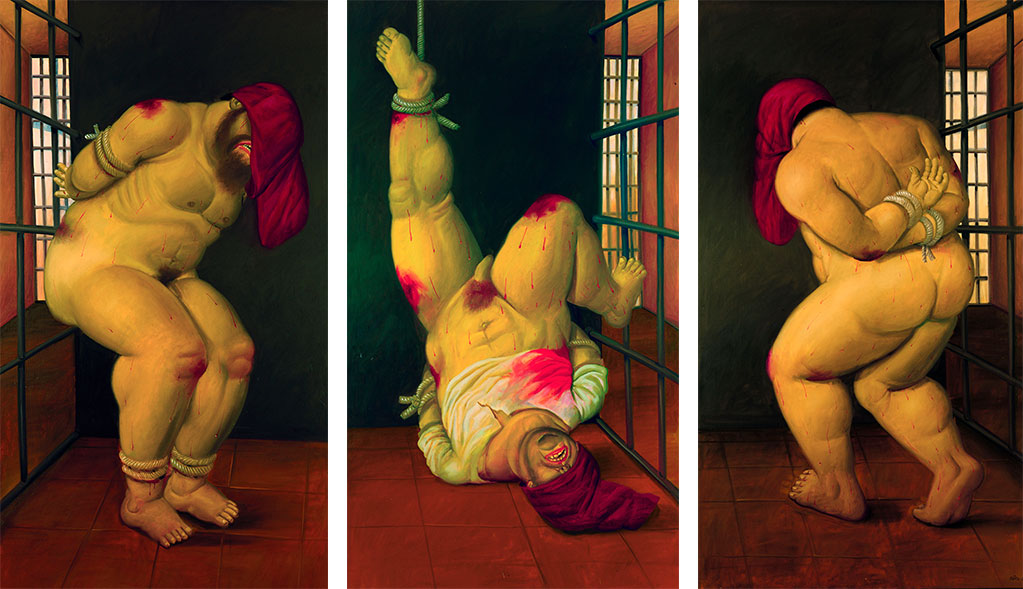
Abu Ghraib #44, 2005. Oil on canvas, 190 × 104 cm (each). Berkeley Art Museum, University of California, United States.
An artist for the people
Botero was always an artist who remained close to the public, someone who understood that beauty could serve as a bridge to our shared humanity. His style, so often associated with irony, abundance and apparent gentleness, contains a critical gaze that emerges with full force in his most dramatic works, where volume ceases to be merely formal pleasure and becomes testimony.
With Vía Crucis, Botero reaffirmed his place in the history of art not only as a renovator of form and pictorial space, but as a humanist capable of turning painting into memory, resistance and moral inquiry. In his hands, beauty becomes an act of courage, inviting us to look directly at what we so often prefer not to see.
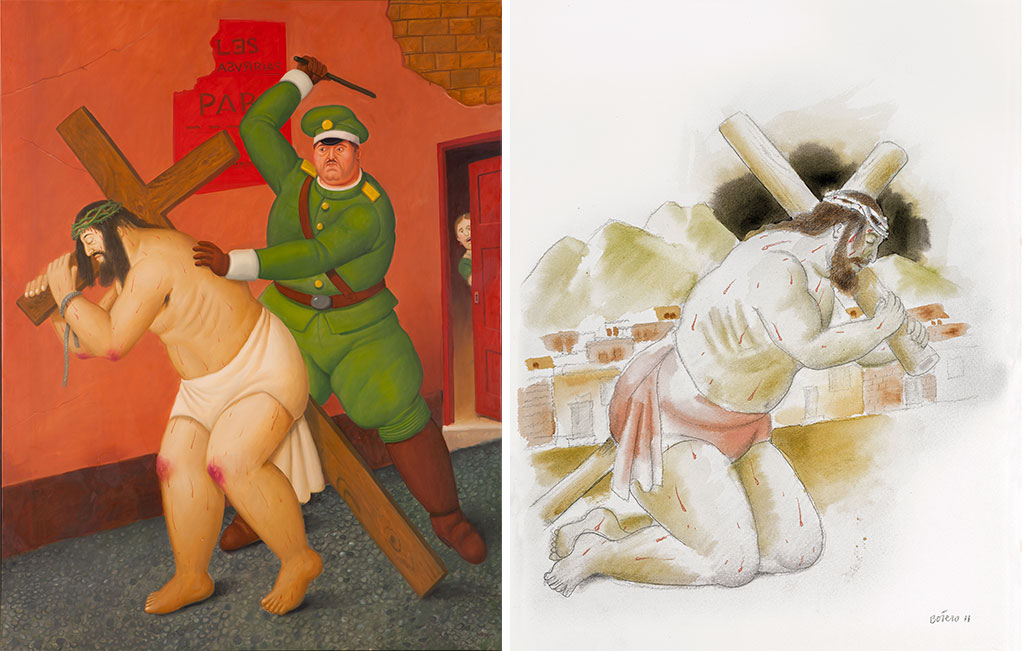
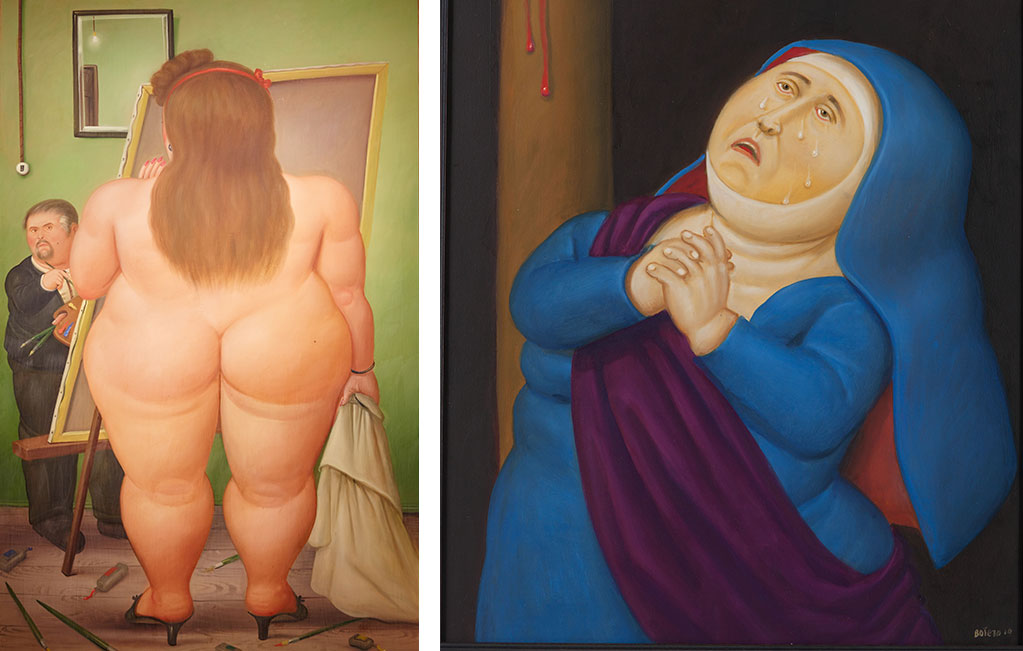
Left: El camino de las penas, 2010. Oil on canvas, 188 × 146 cm. Museo de Antioquia, Medellín, Colombia. ©carlostobonelfotografo.
Right: Jesús cae por primera vez, 2011. Watercolor and pencil on paper, 40 × 30 cm. Museo de Antioquia, Medellín, Colombia. ©carlostobonelfotografo.
VÍA CRUCIS, the body as a site of resistance
– A numbered edition limited to 998 copies, created in collaboration with the artist and the Museo de Antioquia.
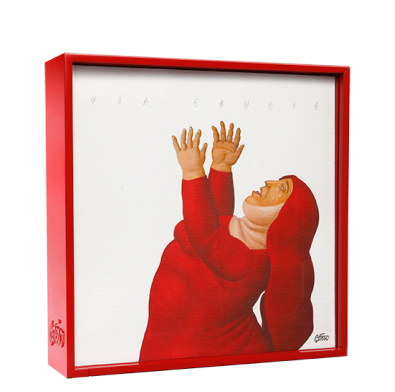
– The set comprises two volumes housed in a display case conceived as a work of art, featuring a silhouetted fragment of the oil painting Cerca de la cruz, published here for the first time, and appearing before the cover of the Art Book.
– The Art Book includes 34 plates bringing together the scenes of the Passion of Christ, reinterpreted by Botero through his characteristic visual language, each one accompanied by a biblical quotation.
– The Study Book brings together the voices of Federico Mayor Zaragoza, former Director-General of UNESCO; David Ebony, American art critic; María del Rosario Escobar, General Director of the Museo de Antioquia; and Camilo Castaño, curator at the Museo de Antioquia. Their contributions examine Botero’s social, cultural and artistic role on the world stage, examining his wider oeuvre and analysing each plate in the edition.