

Peinture-poésie: Miró and the metamorphosis of the book
Joan Miró was a radical creator in the deepest sense of the term: an artist prepared to pursue every visual intuition to its ultimate consequences. He did not break new ground in painting alone. Sculpture, printmaking, ceramics and collage were also fields of exploration in which he tested materials, supports and gestures, always in search of a more direct and essential form of expression.
Driven by this desire to expand the boundaries of art, Miró found a new field of creation in the written word. From his years in Paris and his contact with the Surrealist circle onwards, he immersed himself in poetry and entered into dialogue with it through images, creating books that did not merely illustrate texts, but transformed them. À toute épreuve, created from poems by Paul Éluard and published by Gérald Cramer, became a landmark: an artist’s book that redefined Miró’s relationship with literature and opened up a new way of understanding the union between poetry and painting.
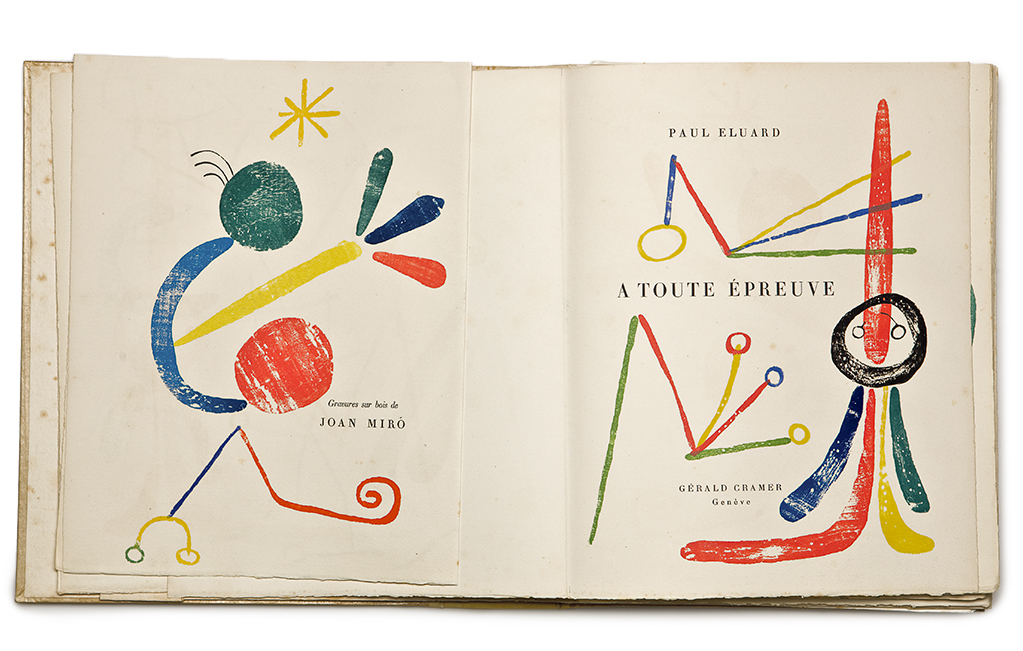
Paul ÉLUARD y Joan MIRÓ. À toute épreuve, 1958. Edición Gérald Cramer. Xilografía, 33,5 × 26 cm. ©Gabriel Ramon. Archivo Successió Miró.
When poetry becomes matter
From the outset, he insisted that his role was not to illustrate Paul Éluard’s poem, but to interpret it. His intention was to create a living dialogue between word and image, in which the book’s textual and visual elements coexisted in a balance that was at once precise and free. For Miró, the book had to become a space of total creation: an autonomous work, rather than a medium subordinate to the text.
Visual poetry had appealed to him instinctively from a very early age. During his time in Paris, André Masson, his neighbour and artistic accomplice, introduced him to a circle of poets who would shape his career: Robert Desnos, Georges Limbour, Raymond Queneau and other leading figures of Surrealism.
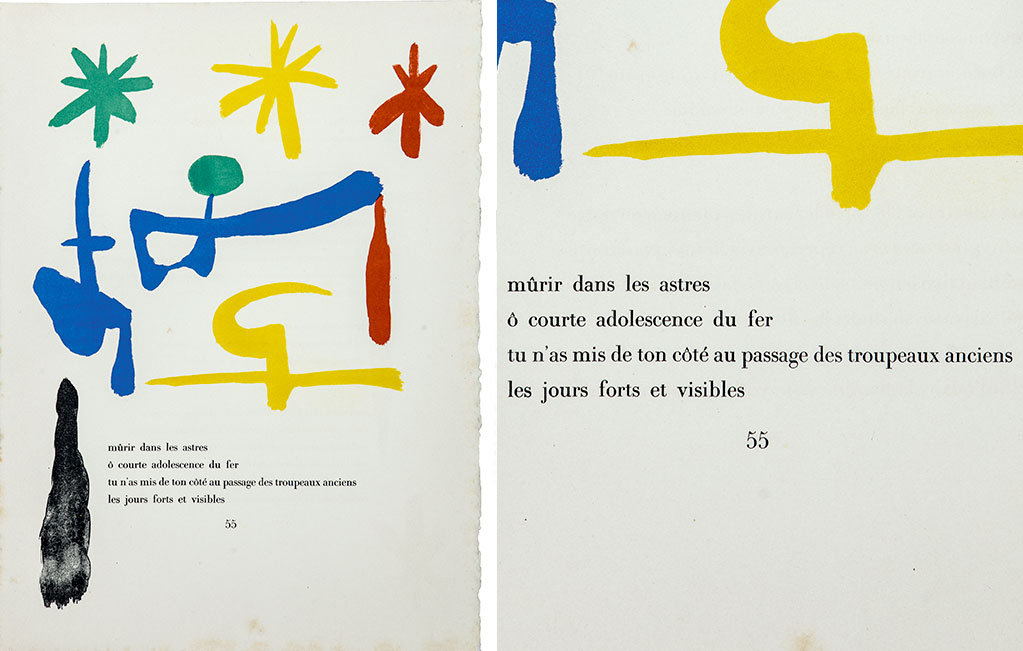
Tristan TZARA y Joan MIRÓ. Parler Seul, 1948 – 1950. Maeght Éditeur. Litografía, 18,2 × 28,9 cm. ©Gabriel Ramon. Archivo Successió Miró.
This relationship between image and text would ultimately define a fundamental part of his work through the concept of peinture-poésie: a fusion in which painting and poetry cease merely to accompany one another and become a single field of resonances. It was at this point that he began to understand the book not as a support, but as a laboratory for experimentation.
His first artist’s book appeared in 1928: a series of stencils, or pochoirs, created to accompany the children’s songs of Lise Hirtz. That project marked a starting point. Although pochoir is not a printmaking technique, it allows multiple copies to be produced. Shapes are cut into zinc plates or other matrices, and the artist uses the stencil to apply colour by hand to specific areas of the page, including over lithographs or etchings.
In André Breton’s Il était une petite pie, Miró took this exploration even further. There, he developed ideas that had already appeared in his painting, particularly his interest in words as inscriptions within the canvas. In one of the pochoirs, a large “X” divides the page into four quadrants: a red disc, possibly alluding to the sun, and the words ciel, pomme and Pierre. With these elements, he constructs provocative associations between text and image, word and object. The “X” acts as a visible, almost grammatical structure, organising meaning around a mysterious axis.
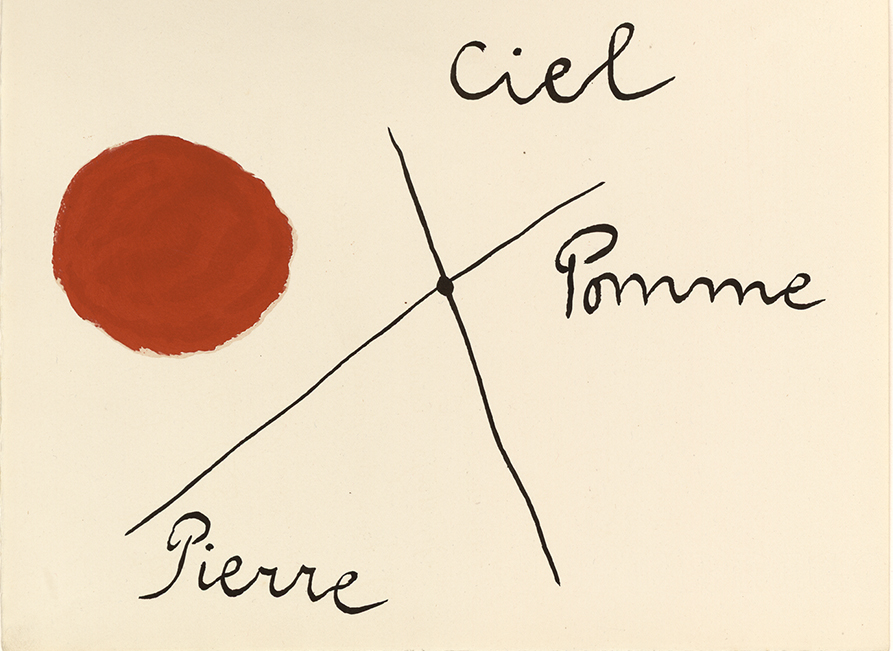
Lise HIRTZ y Joan MIRÓ. Il était une petite pie, 1928. Edición Jeanne Bucher, 32,5 × 25 cm. ©Fundació Joan Miró, Barcelona.
This apparently simple gesture reveals the origins of Miró’s conception of the artist’s book: a place where poetry becomes matter, where language unfolds as form and where every page becomes a field of forces between sign, colour and silence.
Miró’s illustrated books
The artist’s book, as we understand it today, is a twentieth-century creation that reached maturity after the Second World War. Although many bibliophile editions incorporated graphic works by major artists, they remained traditional books: their structure did not form part of their meaning. A true artist’s book, by contrast, transforms the volume into a complete aesthetic object, in which form, sequence and materiality are inseparable from the experience.
Within this context, Joan Miró developed the concept into a language of his own. While working on À toute épreuve, he confessed to Gérald Cramer: “I have carried out several experiments that have allowed me to understand what it means to make a book, rather than illustrate one, which is always something secondary. A book must possess the dignity of a sculpture carved in marble.” This statement encapsulates his ambition: to transform the book into an autonomous creative space, rather than a secondary support.
Over the course of his life, 258 books illustrated by Miró have been catalogued, forming an extensive and varied body of work that encompasses poetry collections, catalogues, bibliophile editions and collaborations with writers and poets close to his creative world, such as Rafael Alberti and Louis Aragon. Yet true artist’s books—those in which he was involved in most aspects of the design and conceived the volume as a total work of art—are relatively few. It is precisely in these projects that his most radical vision is revealed: the word as matter, the image as rhythm, and the book as a visual and poetic experience.
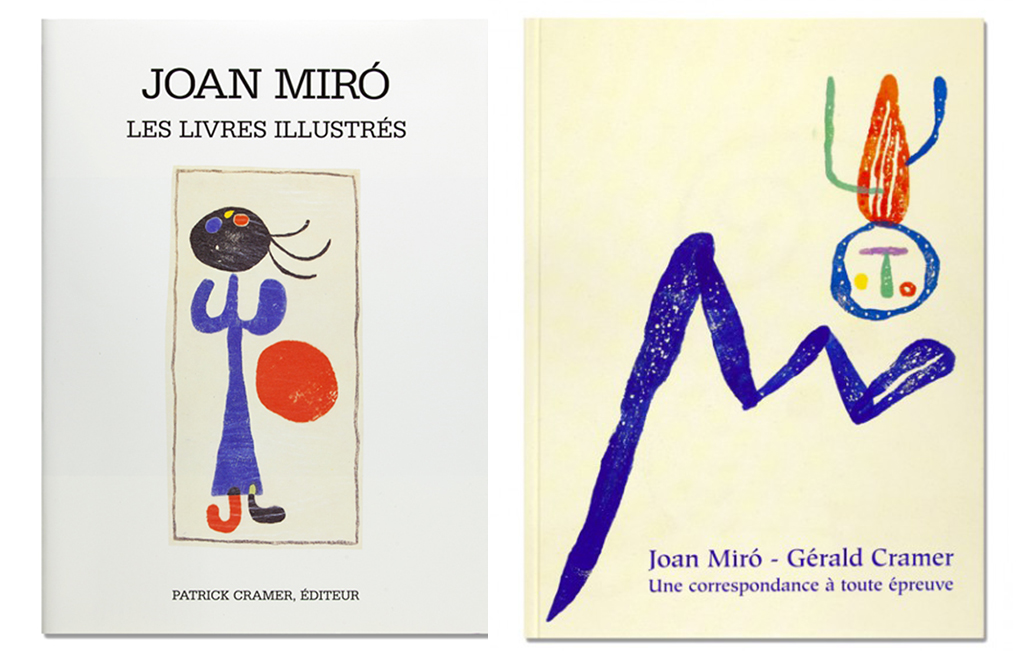
Joan Miró. Les Livres Illustrés, 1989. Patrick Cramer Editeur.
Joan Miró – Gérald Cramer. Une correspondance à toute épreuve, 2002. Patrick Cramer Editeur
He understood that the dialogue between text and image should not be literal, but poetic. His pages establish unexpected associations, visual tensions and silences that broaden the meaning of the poem. Within them, the book ceases to be a container and becomes a living organism, a space in which he could explore, with absolute freedom, the union of gesture, sign and word.
This legacy places him among the great innovators of the twentieth-century artist’s book. His contribution not only expanded the boundaries of the genre, but also opened up a new way of understanding the book as a place where words acquire substance, images set the rhythm and the page becomes an experience.
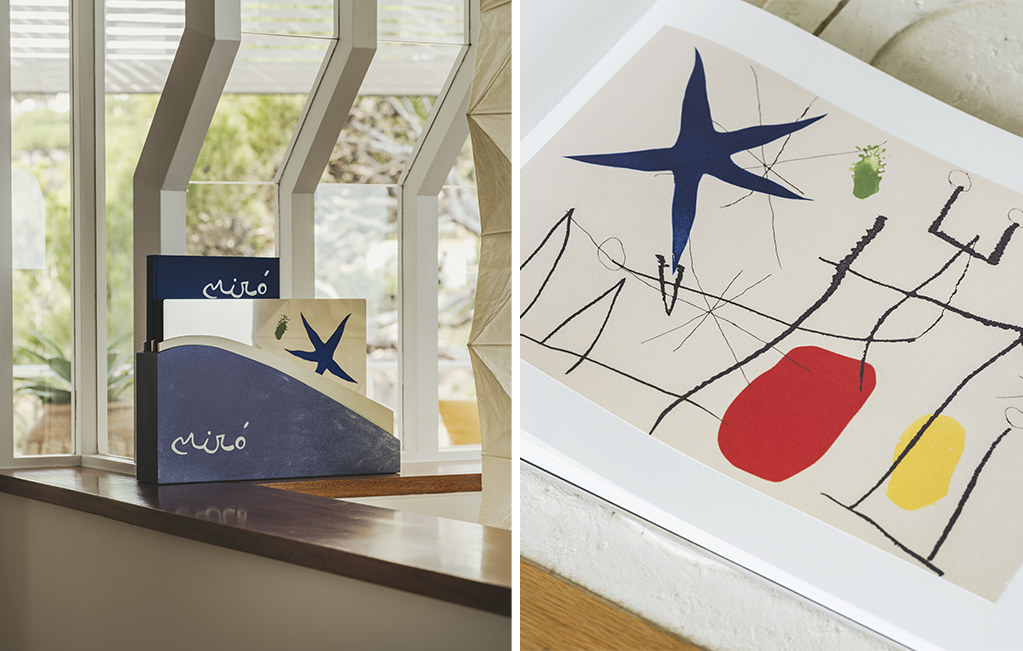
This conception of the book as a total work of art finds a particularly powerful expression in Canticle of the Sun, where word, image and matter are once again brought together in a publishing experience of profound symbolic intensity.
Canticle of the Sun: an exclusive, limited and numbered edition
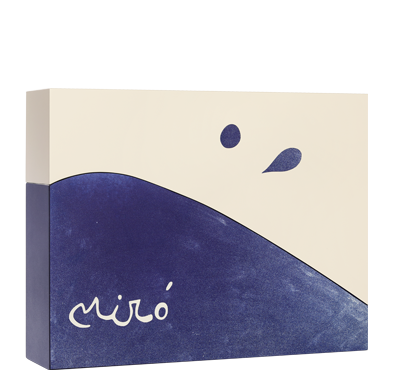
– This piece comprises two volumes and a symbolic case that pays tribute to print number 20 from Miró’s most characteristic series.
– The Art Book contains 33 plates reproduced at 75% of their original size.
– The Study Book traces Miró’s entire career, from his early years in Montroig to his mature period, culminating in this major work, through the perspectives of experts Robert Lubar Messeri, Mercedes Durban Monreal and Jacques Dalarun.