

133 years since the birth of Joan Miró: the artist who redefined art
On 20 April 1893, as spring filled the city of Barcelona with light, a child was born who would go on to transform the artistic language forever. Exactly 133 years ago, Joan Miró came into the world—the creator who turned stars, birds and constellations into his own visual alphabet, recognisable in every corner of the globe.
On the anniversary of his birth, we celebrate not only the artist, but also the visionary who opened new paths for imagination and Surrealism. To mark this special date, we propose a journey through the works that shaped his career and defined his creative universe. Below, we revisit five key pieces that embody his artistic greatness.
- L’Ornière (1918)
One of the paintings that marks a decisive moment in Miró’s search for his own artistic language, where his gaze moves beyond mere observation to become a more intimate and symbolic experience. In this work, the rural landscape of Mont-roig is transformed into a space where reality merges with his poetic sensibility, foreshadowing his later inclination towards Surrealism.
More than a simple depiction of the countryside, the piece is an imaginative reinterpretation of reality. Miró does not paint only what he sees, but what he feels and remembers: a deep connection to the land, identity and nature become symbols. The field ceases to be a landscape and instead becomes an inner space where the real and the fantastical merge into a personal and poetic vision of the world.
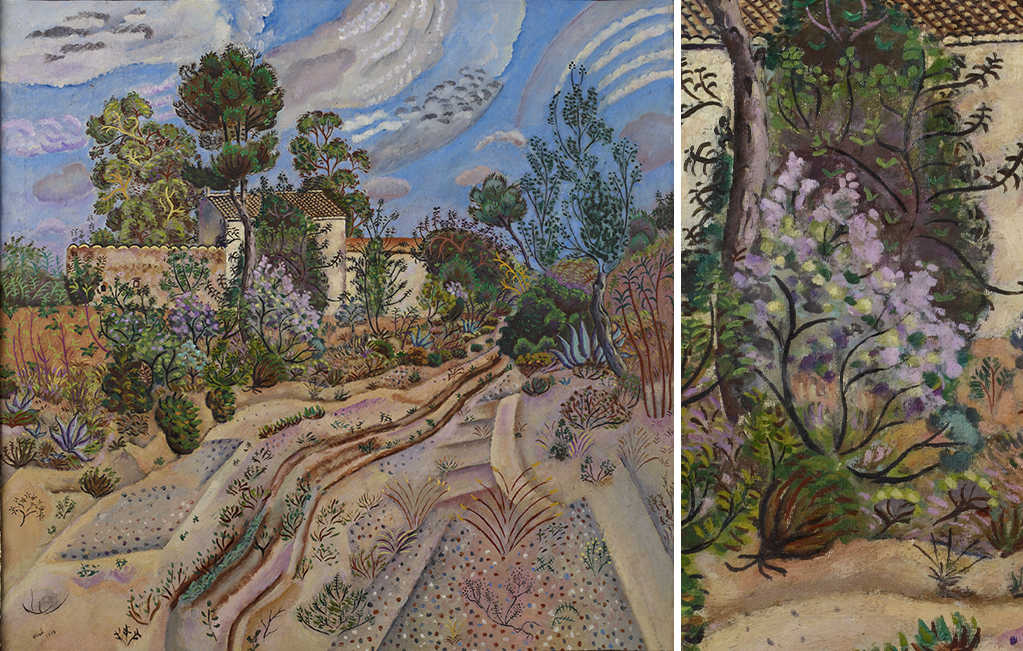
L’Ornière, 1918. Oil on canvas, 75 × 75 cm. © Successió Miró Archive.
- Femmes au bord du lac à la surface irisée par le passage d’un cygne (1941)
This work belongs to the Constellations series (1939–1941), comprising 23 paintings created during one of the most turbulent periods of the 20th century. They reflect the artist’s unmistakable naïve style, which delves into our subconscious to offer an intimate and symbolic vision of reality.
More than a dreamlike scene, it is a silent cry. In 1941, while Europe was engulfed in the Second World War and Spain remained under Franco’s dictatorship, Miró found in painting a means of escape and resistance. Art thus became both refuge and poetic response to the violence and uncertainty of his time.
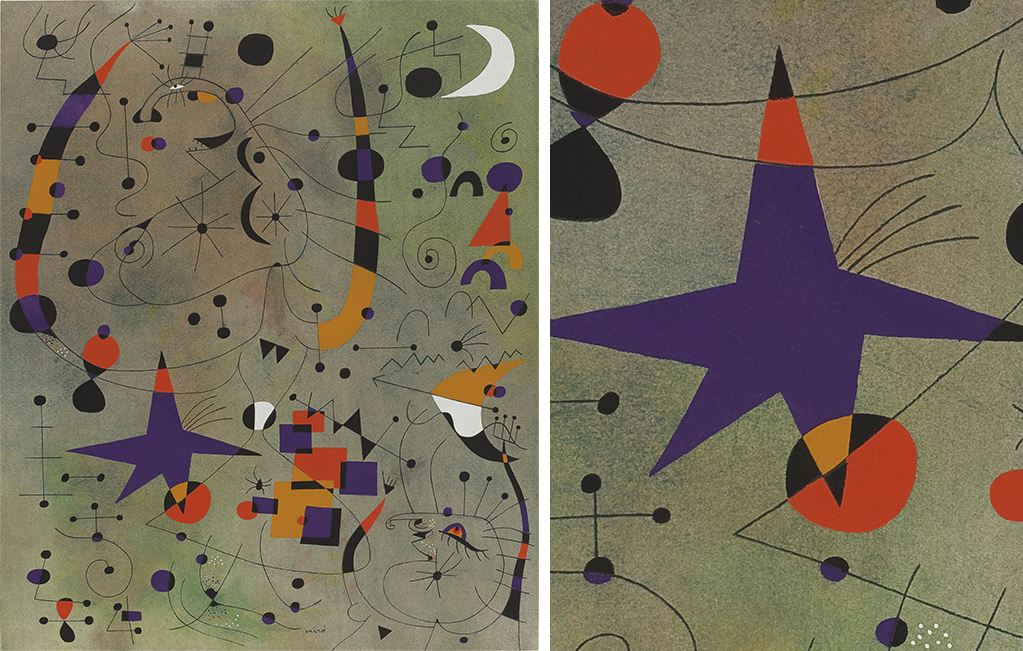
Femmes au bord du lac à la surface iridée par le passage d’un cygne (Women on the shores of the lake, iridescent by the passage of a swan), 1941. © Archive Successió Miró.
- Bleu II (1961)
This composition forms part of the celebrated Blue Triptych, created at the height of Miró’s artistic maturity. Executed in oil on canvas, it stands out for its absolute command of colour and space. The background, covered in a deep ultramarine blue, creates a uniform chromatic field that intensifies the presence of each element.
Across the surface runs a sequence of black dots of varying sizes, alongside a single vertical red line. The composition, seemingly simple, is precisely calibrated: the dots establish rhythm and visual cadence, while the red line introduces contrast. Miró achieves a remarkable expressive intensity, culminating his search for the essential—colour as pure emotion and the sign as a universal language.
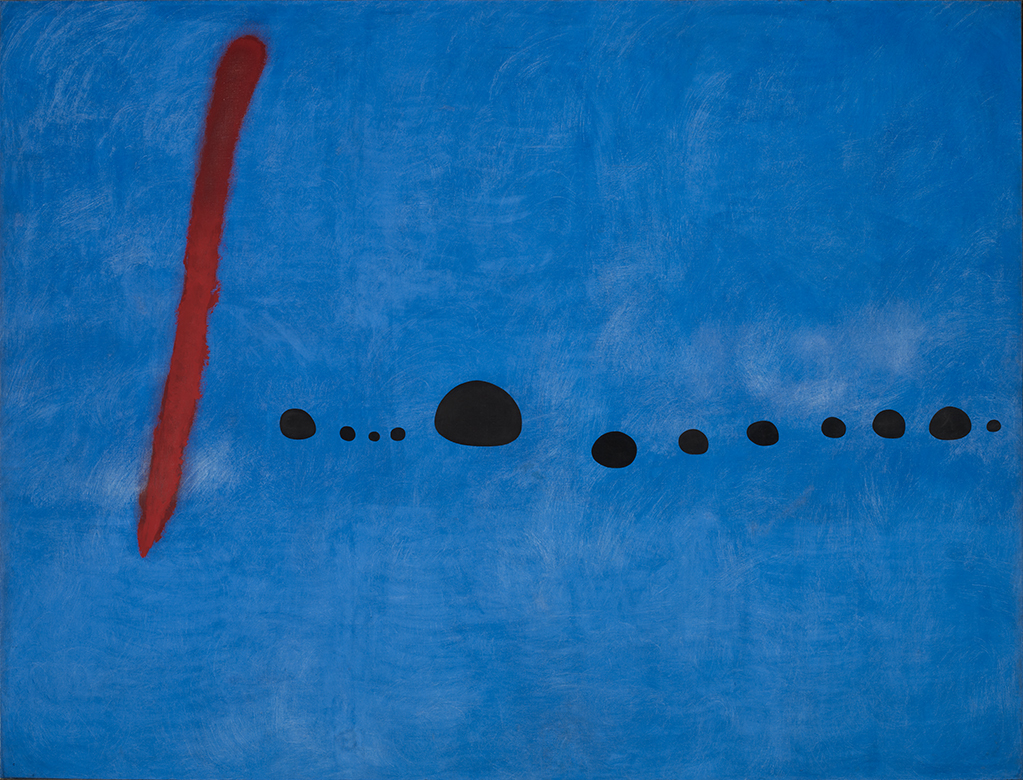
Bleu II/II (Blue II/II), 1961. Oil on canvas, 270 × 355 cm. Musée National D’Art Moderne. Center Georges Pompidou, Paris. © Successió Miró Archive.
- L’Or de l’azur (1967)
This work reflects Miró’s fascination with concise yet highly meaningful compositions. On the canvas, a large blue shape dominates the center, drawing the eye, while small black marks surround it against a golden background, creating a contrast that synthesises his vision of the cosmos and the Earth. The piece reveals Miró’s experimental spirit, combining monochrome signs with references to astronomy in a visual dialogue that seeks to transcend the purely material.
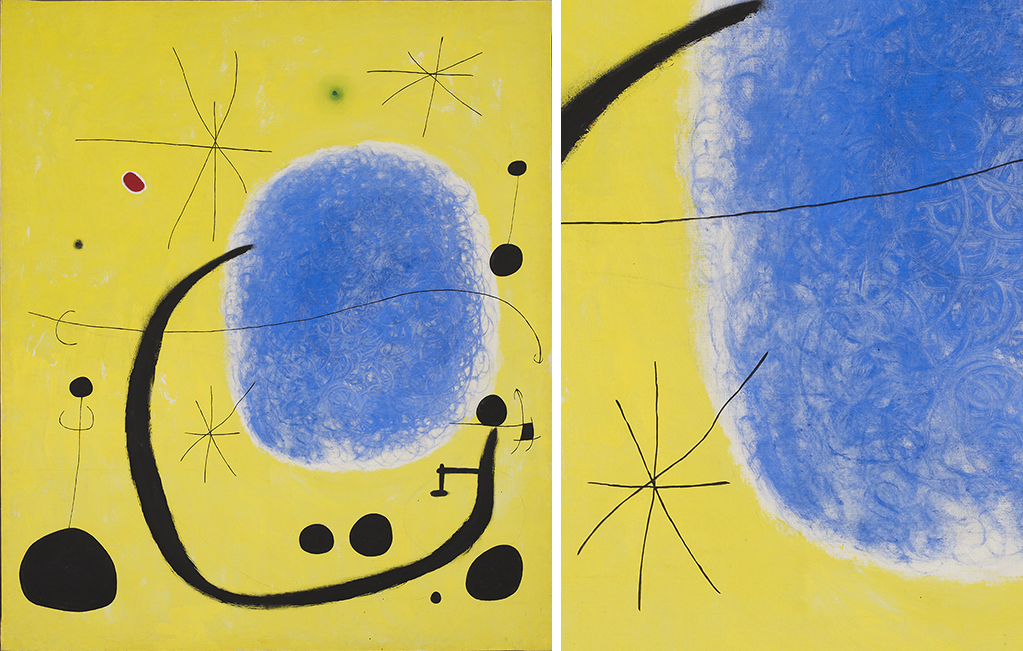
L’Or de l’azur, 1967. Acrylic on canvas, 205 × 173 cm. ©Joan Miró Foundation, Barcelona.
- Mujer y pájaro (1983)
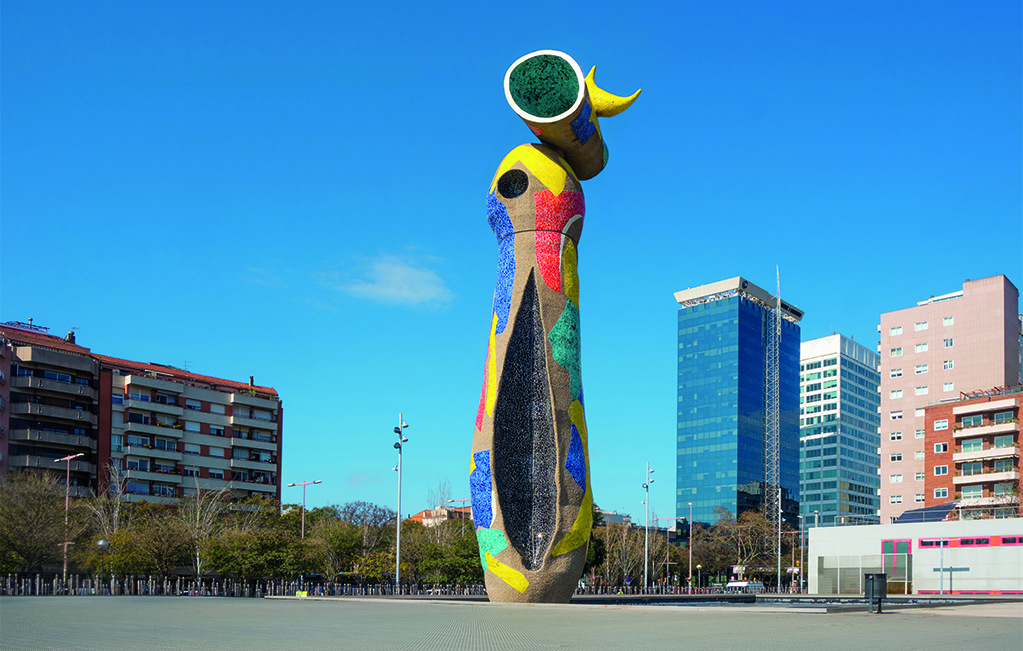
This journey would be incomplete without Woman and Bird, one of his final public works. Inaugurated in 1983, at the dawn of Spain’s democratic era, the city of Barcelona embraced the integration of art into public space. Miró created this monumental sculpture—over twenty metres high—for the park that now bears his name.
The sculpture depicts a female figure crowned with a hat and a crescent moon, also alluding to the bird, a recurring motif in his visual universe. These birds, which connect the earthly realm with the cosmos, are central to his poetic language. To fully understand the piece, one must enter his iconographic world, where colour, element and dream converge into a powerful presence that engages both with its surroundings and with the city itself.
Death erases physical presence, but not legacy. In the case of Joan Miró, his work continues to resonate with undiminished force. His universe—made of signs, colour and constellations—remains in dialogue with those who contemplate it. Physical absence is not an end, but a transformation.
As long as someone pauses before his work and feels something stir within, he will remain there, more alive than ever. For art is, ultimately, the most enduring way of remaining, and Miró’s spirit chose to live on forever in colour, gesture and the imagination of the world.
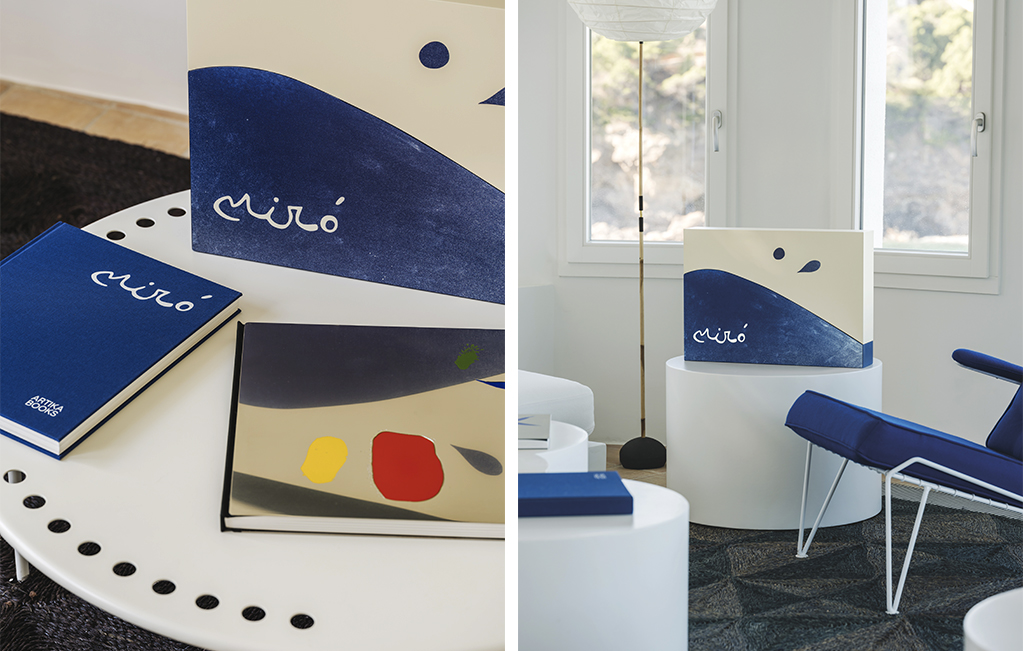
The universe of Joan Miró: an exclusive, limited, and numbered piece
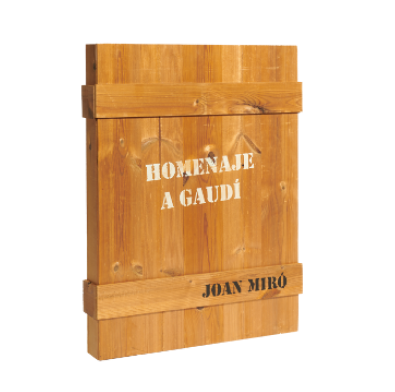
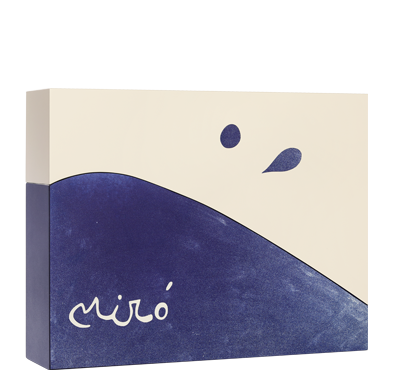
– An edition composed of two volumes and a symbolic case that pays tribute to engraving number 20 from Miró’s most iconic series.
– The Art Book features 33 plates reproduced at 75% of the original size.
– The Study Book traces Miró’s life, from his early years in Mont-roig to his period of artistic maturity, through the perspectives of experts Robert Lubar Messeri, Mercedes Durban Monreal, and Jaques Dalarun.