

Traveling to tell stories: the photographic legacy of Steve McCurry
When one looks at a photograph by Steve McCurry, it is impossible not to recognize his mastery of the medium. As writer and journalist Mario Calabresi explains in the edition Capturing Life: “His photographs, so capable of speaking to anyone, give those who observe and enjoy them without overthinking the feeling that they are born of pure instinct, of an innate talent for capturing the theater of the world in a fleeting moment.”
This feeling is no coincidence. The freshness and energy of his images are the result of patience, perseverance, and determination—qualities that have enabled the photographer to capture the very best of each country he has visited.
His body of work is the product of constant dedication, involving relentless travel and long periods away from home in order to discover new customs and document stories that had never before been told.
The many journeys he has undertaken throughout his life have allowed him to capture unforgettable moments for society—some widely recognized, others less known yet equally meaningful. His true calling has always been travel reportage: telling stories about people, traditions, cultures, and societies through photography.
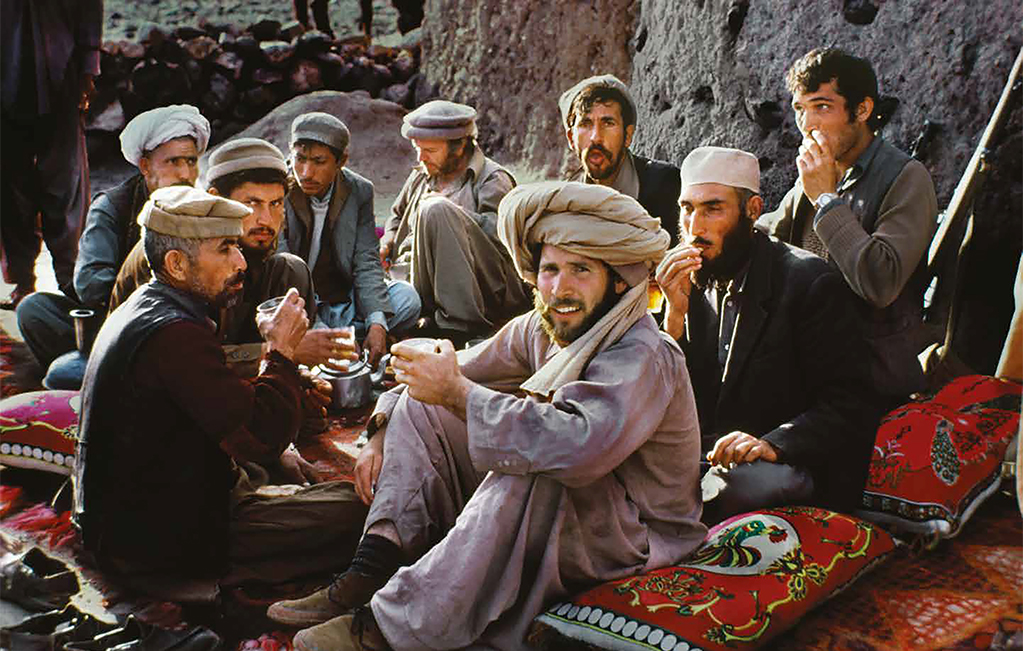
Steve McCurry drinking tea, Afghanistan (1980)
Until then, McCurry had never photographed a war. Afghanistan became the first conflict he documented in his career. To do so, he entered the country clandestinely and joined a group of mujahideen fighters. For three weeks, he traveled at night and on foot, surviving on bread and cheese, unable to communicate properly with his companions. During that time, McCurry documented the group’s daily routine and captured scenes and moments that no one had previously been able to witness. After his first journey, he returned months later and succeeded in taking the first images of the Afghan conflict—photographs that revealed to the world the reality of what was happening in the country.
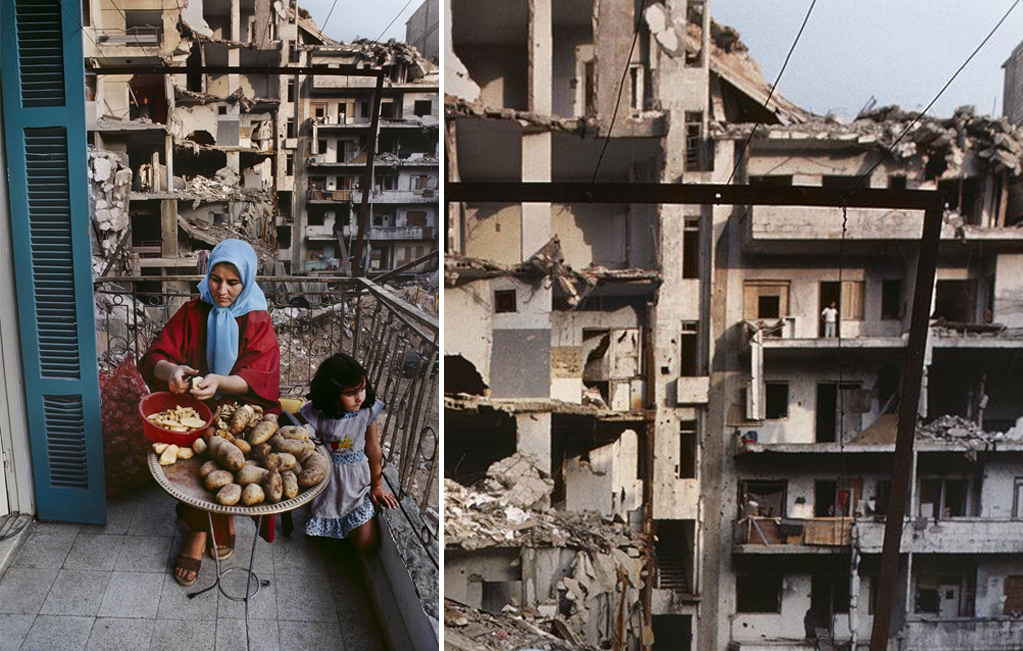
Scene on a balcony in Beirut, Lebanon (1982)
The worldwide success of his photographs from the Afghan war led him, two years later in 1982, to document the Lebanese Civil War. His ability to center individuals and reveal the humanity that persists even amid violence and death allows his images to transcend mere war documentation. His photographs become individual narratives of those who live daily with the consequences of conflict and are forced to adapt their lives to a deeply devastating reality.
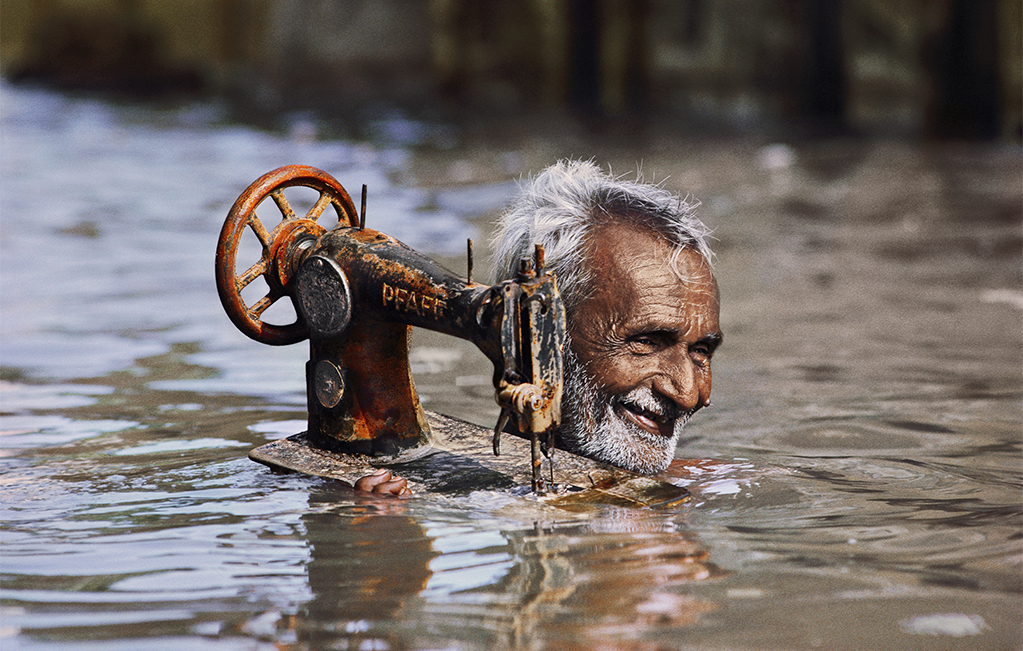
Tailor during the Monsoon floods in Porbandar, India (1983)
His longing for experience led him on an extended journey through India, as well as Indonesia, Sri Lanka, and Nepal, with the goal of chronicling the monsoon. The photograph Monsoon Girl, taken by New Zealander Brian Brake, inspired McCurry to show how millions of people live each year alongside extreme natural phenomena. Camera in hand and water up to his chest, McCurry walked through the streets of Porbandar as the downpour began. It was there that he encountered a tailor carrying his sewing machine on his shoulder. The image became an embodiment of fatalism: the figure of a man accepting the overwhelming force of nature in contrast to human fragility.
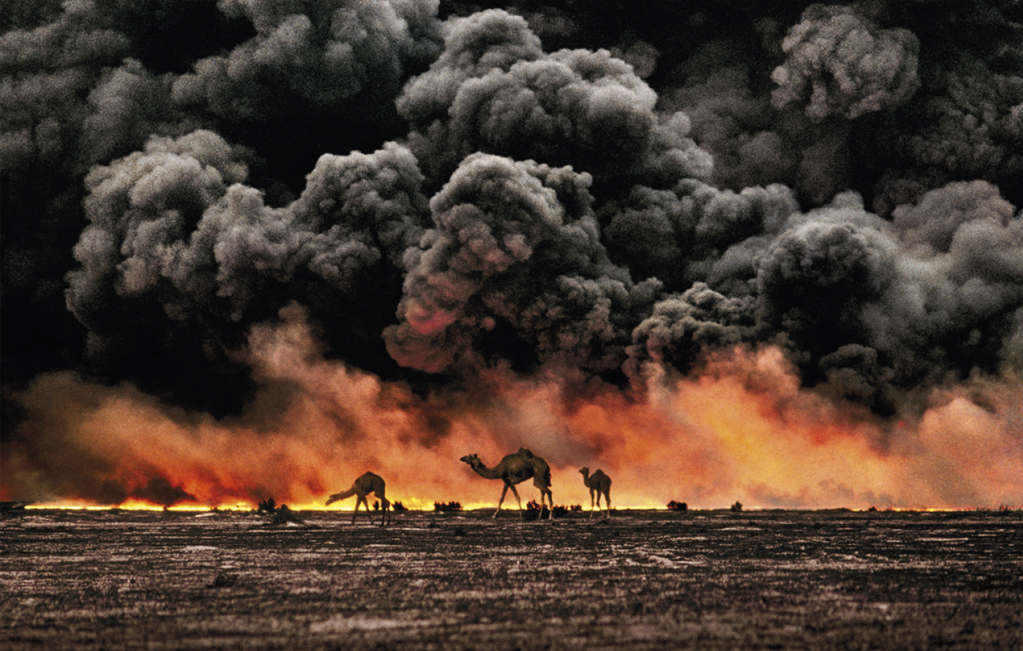
Camels in a burning oil field in Al Ahmadi, Kuwait (1991)
Taken during the First Gulf War, this photograph stands as testimony to the environmental consequences of war. McCurry’s aim was not to document the military conflict itself, but to show the world what remains of a country after devastation. The image possesses striking visual power: in the background, oil fields burn uncontrollably while camels wander in search of food. Their home is no longer the same; war has destroyed everything, ravaging nature and disrupting the balance of life. Only silence, desolation, and profound sadness remain in the landscape.
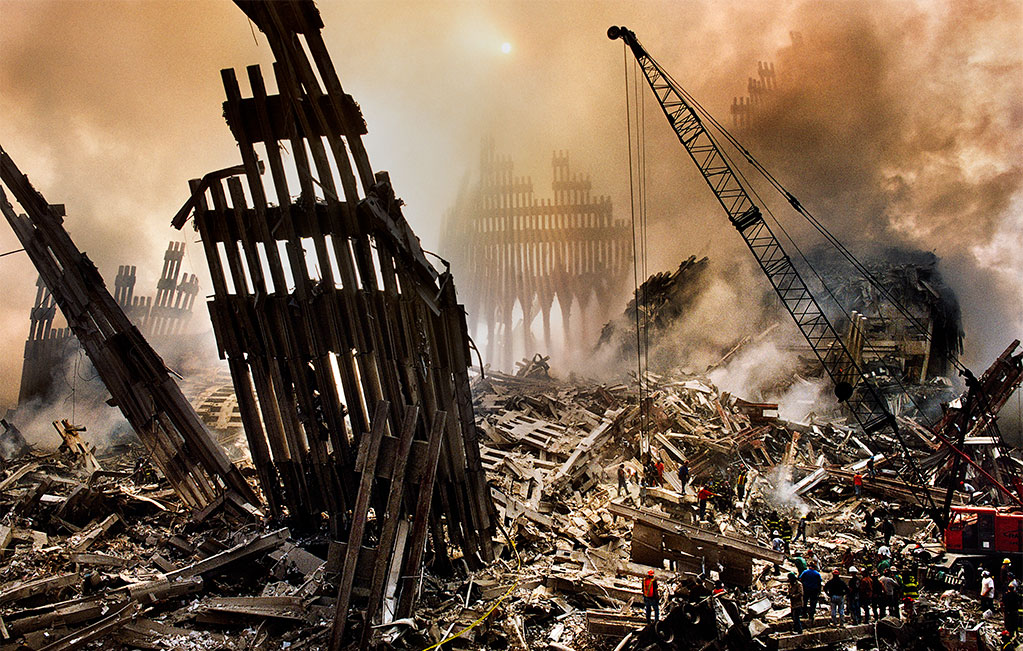
Ruins after September 11 in New York, United States (2001)
Steve McCurry has an uncanny ability to find himself in places marked by devastation. In 2001, he was returning from a trip to Tibet when, on the morning of September 11, he awoke and headed to his photography studio in Washington Square. Looking out the window, he witnessed the attack on the Twin Towers. Faced with the magnitude of the catastrophe, he decided to document the event. He went out into the street and, camera in hand, began moving toward Ground Zero, walking in the opposite direction of those fleeing. The photographs he took documented the state in which the buildings were left—reduced to rubble after the loss of thousands of lives.
After tracing several of Steve McCurry’s journeys, it is astonishing to realize how many times he has been a direct witness to realities of the world that remain unknown to many. His extraordinary work has established him as one of the great contemporary photographers. Yet, far from feeling fully satisfied, he himself admits: “I’m not sure I’ve ever felt that I’ve fulfilled my dreams, because I’m still driven by an insatiable curiosity to keep exploring, to discover new places and new people.” That constant restlessness is precisely what keeps his vision alive and gives meaning to a body of work that continues to grow and inspire.
A limited edition, numbered and signed by Steve McCurry
– “Capturing Life is the definitive collection of my work: a piece that represents what I would like to be remembered for.” — Steve McCurry
– The artist has been involved in every stage of the project’s creation, from the selection of the iconic images to the signing of each of the 2,998 copies.
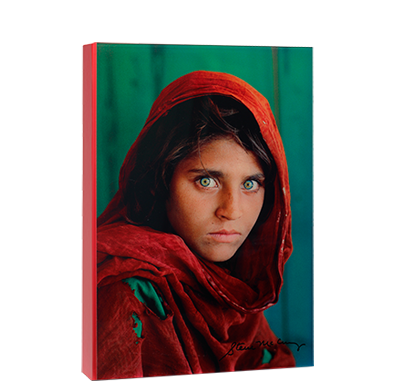
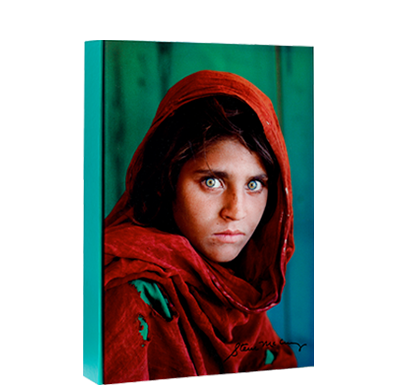
– The piece consists of two volumes and a spectacular case that pays tribute to Afghan Girl, the photograph that appeared on the cover of National Geographic in 1985.
– The Art Book presents 40 original photographs, reproduced with the highest quality and accompanied by McCurry’s personal commentary.
– The Studio Book explores the photographer’s artistic and personal journey through reflections by Pico Iyer and Mario Calabresi.