

Botero: a contemporary review of Western art
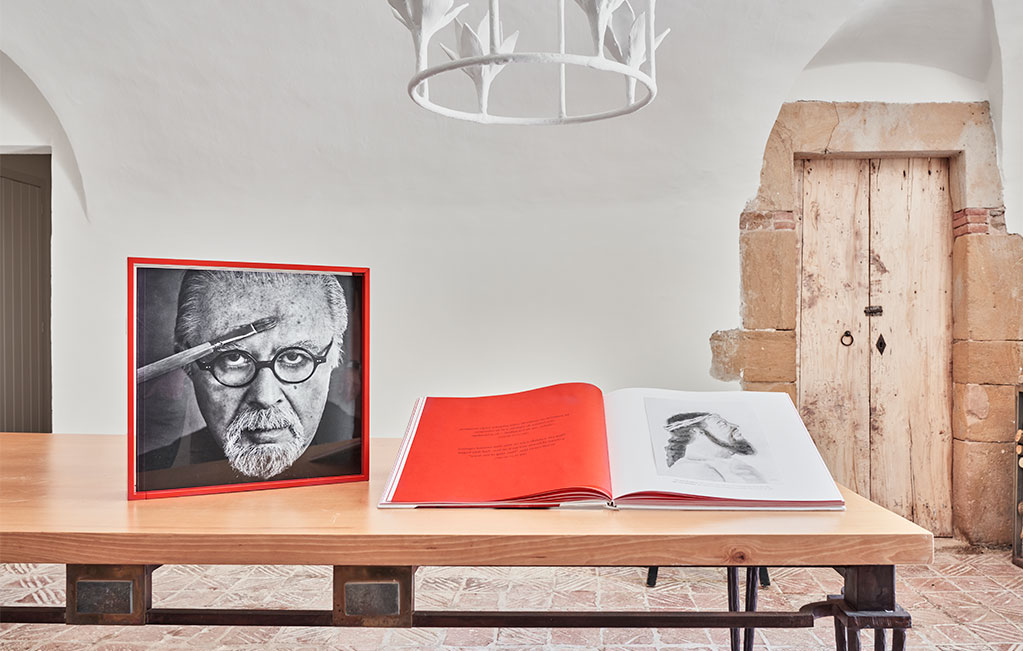
It has been two years since the death of this great master, and to celebrate him we revisit his work, just as he himself revisited the history that preceded him. For example, in the Via Crucis series, his art —pure color, volume, and monumentality— draws on Western references, focusing especially on the martyrdom of Christ. Alongside this highly personal and contemporary approach, this retrospective view is less about devotion to stories and scenes than about the will to bring their ideas closer to the new complexities of the present. Boterism has its own history, and his personal evolution is reflected in his painting. Contemplation of his work, together with the precise observations of Camilo Castaño, research curator at the Museum of Antioquia and contributor to the artist’s book Via Crucis, situates the artist in the past from a present perspective.
Color, technique, and concept over time
In an early stage, we see a more formal Botero, focused on building his own style and driven by an imperative desire for monumentality that connects him to muralism. These are paintings centered on a face or a body, without giving voice to a specific thematic line.
“His characters flood, inundate, the pictorial space. They are true giants, monoliths, visually powerful, but also silent.”
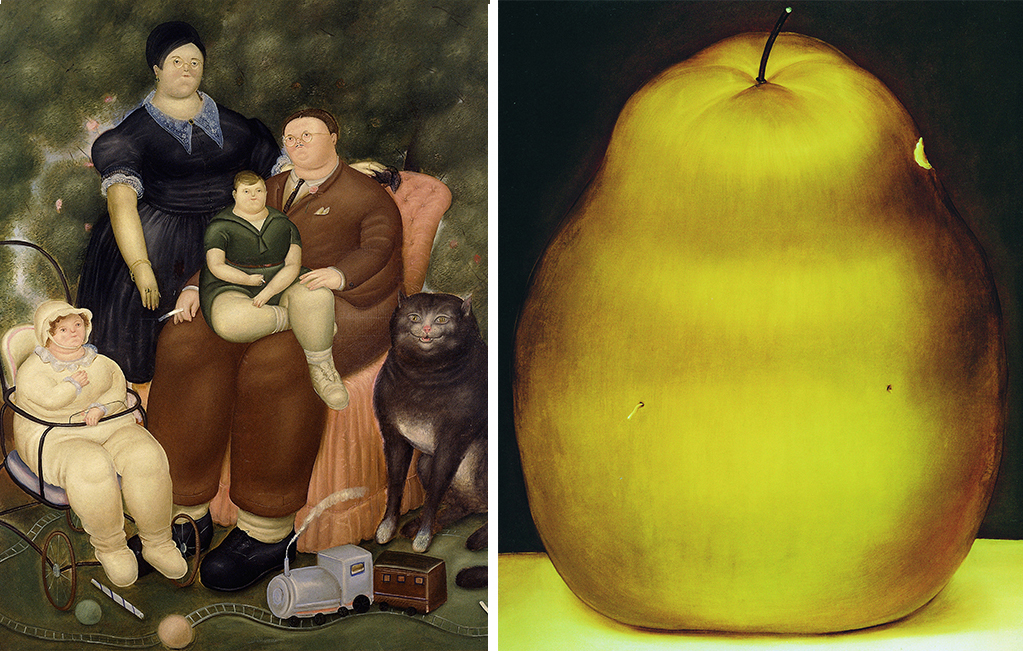
Left: Escena familiar (Family scene), 1969. Oil on canvas, 211 x 195 cm.
Right: Pera (Pear), 1976. Oil on canvas. 241 x 196 cm.
As the artist turned his ambitions and concerns into lived experiences between the unstoppable passage of time and fleeting destinations, his presence in the art world integrated conceptual concerns issued as relevant as the technical and visual ones.
At all times, these voluminous figures have suggested something beyond an appearance that breaks with the classical way of representing the human body. Yet the feeling these represent at both beginning and end of his career shifts. From embodying a grandiose sensuality, they become images of the different forms of human suffering. In the Via Crucis edition, this artistic maturity is clear: “he raises an issue about pain, about torture, and one can feel these issues in the bodies,” notes Castaño.
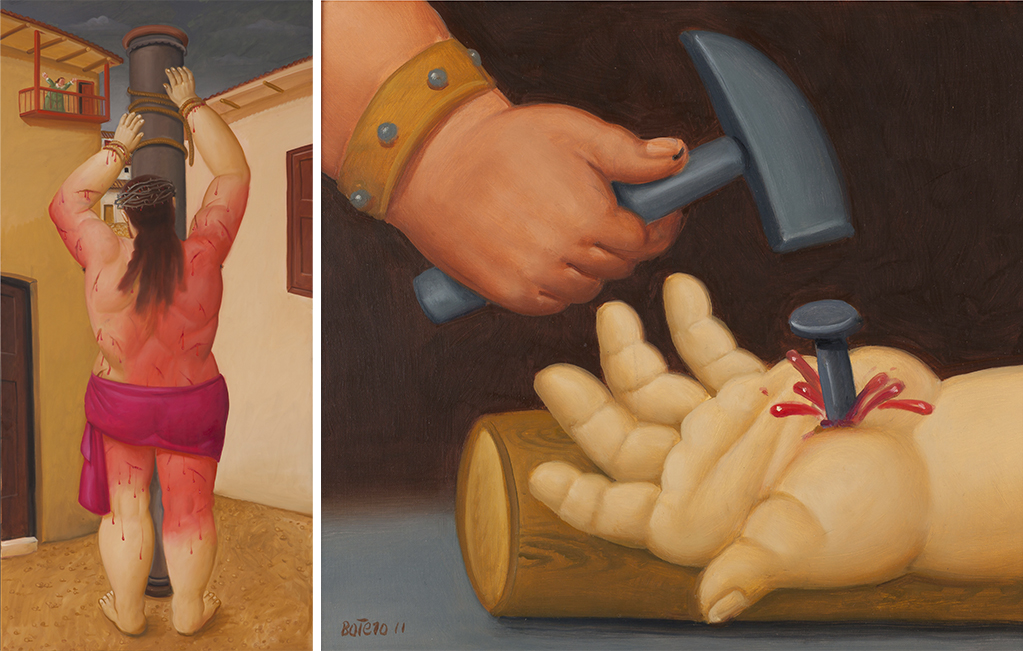
Left: Flagelación de Cristo (Flagellation of Christ), 2010. Oil on canvas, 205 × 99 cm. Antioquia Museum, Medellín, Colombia. @carlostobonelfotografo
Right: Los clavos (The nails), 2011. Oil on canvas, 30 x 40 cm. Antioquia Museum, Medellín, Colombia. @carlostobonelfotografo
This shift in meaning is accompanied by his palette: alongside style, color also becomes an emotional resource. In no stage of his career does Botero aim to establish a relationship with reality: his paintings are not panoramic views, but extrapolations of a detail. When he painted Medellín, for example, the final piece was a portrait of the attached feeling rather than of the city itself.
“The mastery of this artist is to turn this matter of place into an idea about himself, because if we were to look for the Medellín that Botero inhabited when he was young and carried with him in the development of his work, we would not find it.”
Preferred masters and past periods
Botero’s universe, uniquely and unmistakably defined, takes its first steps with influences as evident as they were essential for his creation, with two names standing out above all. In his religious scenes and series, there is much of Andrea Mantegna, particularly in the treatment of the martyrdom of Christ. The second one is Piero della Francesca, in a much more formal parallel first seen in the structure of the faces of his pictorial characters.
Of the many movements and artistic periods that built Western art, Botero drew above all from the Baroque, though his painting enjoys a sense of humor that softens both the weight of the movement and the analysis he makes of this history. These glimpses at the past are not configured as a template on which to develop his work, but as a desire to accommodate what was prescribed in new spaces and times. Such decontextualization of stories or their protagonists is frequent, as with the figure of Christ, whom he places in Central Park in New York (Crucifixion, 2011) or in his Latin America (Jesus and the crowd, 2010).
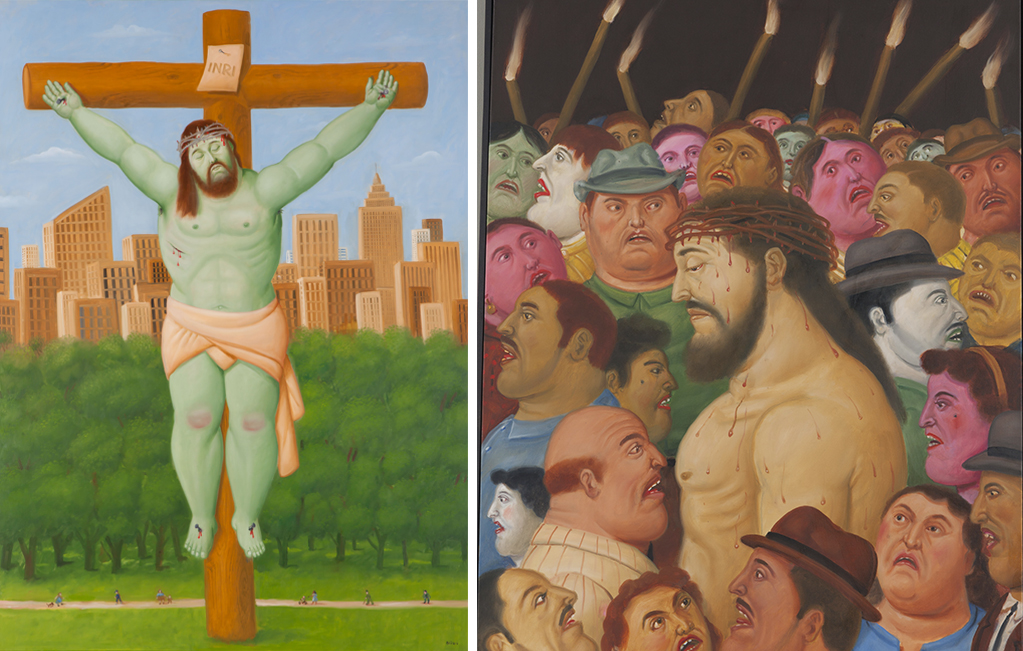
Left: Crucifixión (Crucifixion), 2011. Oil on canvas, 201 × 127 cm. Antioquia Museum, Medellín, Colombia. @carlostobonelfotografo
Right: Jesús y la multitud (Jesus and the crowd), 2010. Oil on canvas, 106 x 81 cm. Antioquia Museum, Medellín, Colombia.
To the world from Medellín: between what’s universal and what’s personal
“Botero sees himself as an individual who inherits this tradition and, in some way, establishes a conversation across time with artists of many moments and places to build his own history.”
The artist’s documentary process embraces two paths: the reading of tradition and legend, and the observation of the present. Through this second path, Botero moved from Medellín to America and Europe, yet never lost his sense of home. These journeys shaped his artistic career in essential ways, structuring above all the general conceptualization of his work: the history of Western art.
Filled with references contained in thick, robust bodies, the artist managed to build a personal universe that feels like being between a memory and a dream, between Colombia and the rest of the world. The volumes and proportions, one of his most instantly recognizable hallmarks, distinguish him in this reading that assumes him as a new contemporary narrator of tradition and a bridge between the past and the present, allowing audiences to feel part of something they never lived. As Castaño points out in his interview for ARTIKA:
“Botero almost presents us with a paraphrase, a literary figure of exaggeration of reality that makes us feel it emotionally and affectively when we contemplate it.”
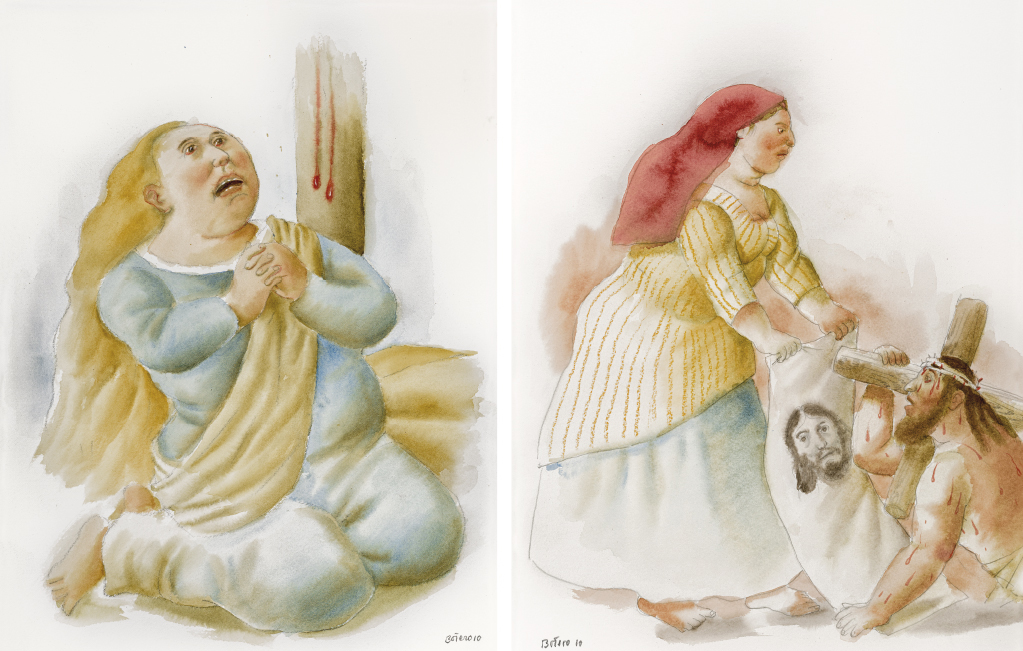
Left: Cerca a la cruz (Near the Cross), 2010. Watercolor, pencil and colored pencil on paper, 40 × 30 cm. Antioquia Museum, Medellín, Colombia. @carlostobonelfotografo
Right: Jesús y Verónica (Jesus and Veronica), 2010. Watercolor, pencil and colored pencil on paper, 40 × 30 cm. Antioquia Museum, Medellín, Colombia. @carlostobonelfotografo
‘VIA CRUCIS,’ A round trip through time
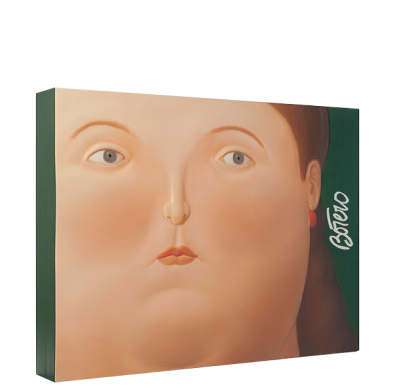
– A numbered, limited edition of 2.998 copies, created in collaboration with the artist and the Antioquia Museum.
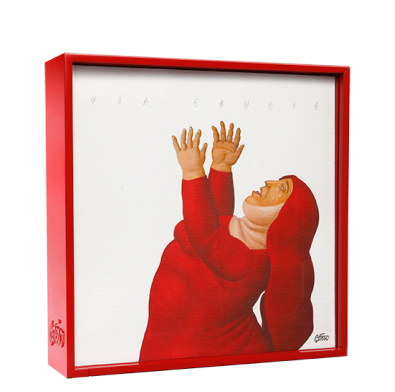
– Composed of two volumes, presented in a display case whose main image is a silhouetted detail from the previously unpublished oil painting Near the Cross, preceding the cover of the Art Book.
– The Art Book includes 34 plates that depict the Passion of Christ through scenes reinterpreted by the artist in his unique style, each accompanied by a biblical quote.
– The study Book features the voices of Federico Mayor Zaragoza, former Director-General of UNESCO; David Ebony, American critic; María del Rosario Escobar, Director-General; and Camilo Castaño, curator at the Museo de Antioquia. Their contributions address the social, cultural, and artistic role of Botero on a global level, studying his work in general and analyzing each plate of the edition.